
Cold formed steel fabrication India — purlins, girts, and sections for industrial buildings
Cold formed steel fabrication in India covers the production of structural sections made by bending and rolling thin gauge steel sheet at room temperature, rather than hot-rolling thicker plate at high temperature. The result is a family of lightweight, efficient structural sections — Z purlins, C purlins, C girts, angle sections, and hat sections — that are used extensively in the secondary structure of industrial buildings, warehouses, and pre-engineered buildings. Cold formed steel sections in India support the roof cladding and wall cladding of almost every steel-framed industrial building constructed in the country, and the specification and quality of these sections directly affects the performance of the building’s envelope. Suncorporation supplies cold formed steel sections for industrial building projects across India.
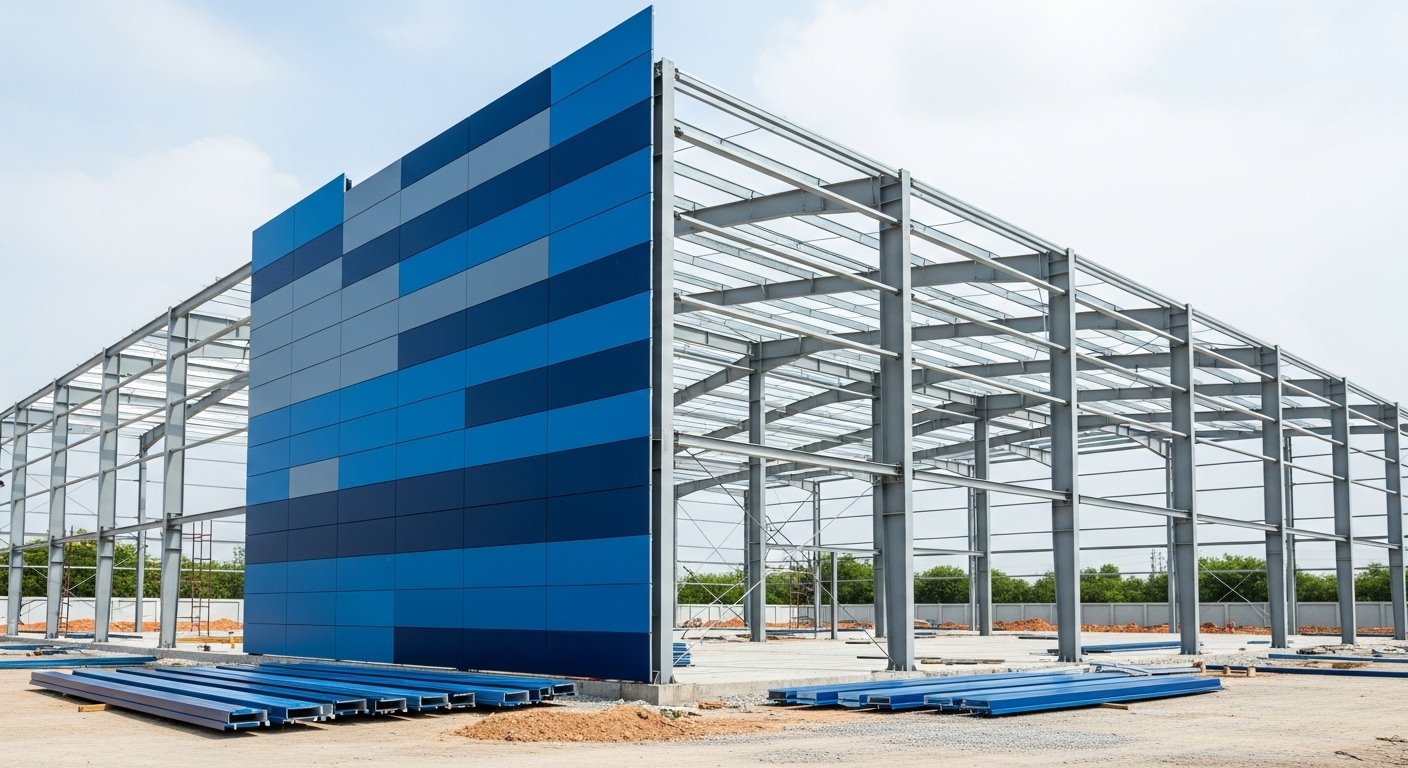
Cold formed steel sections used in Indian industrial buildings
Z purlins — roof purlin for industrial sheds
Z purlins — so called because their cross-section resembles the letter Z — are the standard roof purlin for industrial buildings and pre-engineered buildings in India. The Z shape allows adjacent purlins to overlap at the splice, creating a continuous purlin system where the overlapping sections provide continuity of bending stiffness at the rafter connection. This overlap system is more efficient than a simply supported purlin — it reduces the design span and allows a lighter section to be used for a given purlin spacing and roof load. Z purlins in India are typically made from 1.5mm to 3.0mm thick high-tensile steel sheet to IS 1079 or equivalent, in depths from 100mm to 300mm, in standard lengths of 6 to 12 metres.
C purlins and C girts — purlin and wall girt sections
C sections — also called channel sections or lip channels — are used as roof purlins where a simpler, non-overlapping design is preferred, and as wall girts on all four sides of the industrial building. The C section girt carries the wall cladding sheet from column to column, resisting the wind suction and pressure on the building wall. Girt design in Indian industrial buildings follows IS 801 — the code of practice for use of cold-formed light gauge steel structural members — with the girt span, section depth, and material thickness selected to limit deflection of the wall panel to L/150 under wind load.
IS 801 — cold formed steel design in India
IS 801:1975 — Code of Practice for Use of Cold-Formed Light Gauge Steel Structural Members in General Building Construction — is the primary Indian standard governing the design of cold formed steel sections used in industrial buildings. IS 801 covers member capacity calculations for Z and C sections including local buckling of thin walls, distortional buckling of the flange-lip assemblies, and lateral-torsional buckling of the full member. These buckling modes are unique to cold formed steel and are not covered in IS 800:2007, which applies to hot-rolled sections. Getting the cold formed steel design right for Indian wind zone and IS 875 Part 3 wind loads requires applying IS 801 correctly — a point of difference between properly engineered cold formed steel systems and the undocumented sections supplied by many small cold formed steel producers in India.
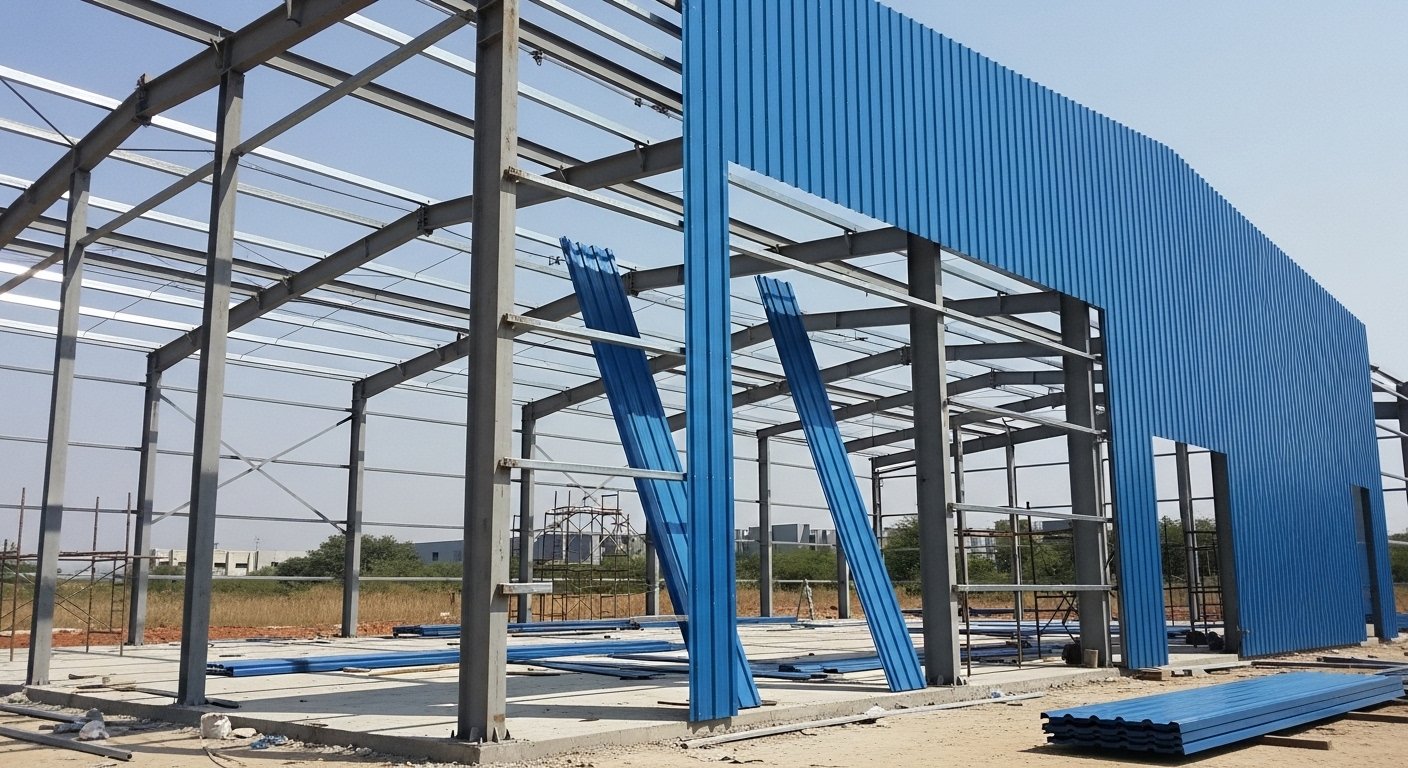
Cold formed steel fabrication — material and coating
Cold formed steel sections for Indian industrial buildings are made from high-tensile steel sheet — typically grade S350 or S550 with a minimum yield strength of 350 or 550 MPa respectively. The higher yield strength of cold formed steel compared to standard IS 2062 Grade E250 mild steel (250 MPa yield) allows thinner sections to carry equivalent loads, which is the source of the weight efficiency of cold formed sections compared to hot-rolled sections for secondary structural applications. The base material is coated with either hot-dip galvanising (Z275 or AZ150 Galvalume) to protect the section from corrosion in the building’s atmospheric environment. In coastal or aggressive industrial environments, heavier coating weights (Z350 or Z450) are specified.
Cold formed steel fabrication cost in India — 2026
- Z purlins, 1.5mm to 2.5mm, galvanised Z275: Rs 70,000 to Rs 90,000 per MT ex-factory, including straightening, cutting to length, and bay punching.
- C girts, 1.5mm to 2.5mm, galvanised Z275: Rs 70,000 to Rs 90,000 per MT ex-factory.
- Heavy cold formed sections, 2.5mm to 4.0mm, for heavy cladding or special applications: Rs 85,000 to Rs 1,10,000 per MT. Heavier gauge, less efficient use of the cold forming process, so cost per MT is higher.
- Supply and erection of complete cold formed steel secondary system: Add Rs 15,000 to Rs 25,000 per MT for field installation — fixing brackets, anti-sag rods, and bridging channels included.
Contact Suncorporation for cold formed steel fabrication. Also see: Pre-engineered buildings India | Industrial shed fabrication | Industrial shed roofing | Structural steel Hyderabad