
Structural Steel Fabrication Services in India
Suncorporation Fabricators & Engineers provides structural steel fabrication in India from our own workshop at Plot No. 36, Road No. 80, Phase V, Jeedimetla Industrial Estate, Hyderabad. We fabricate columns, beams, built-up sections, plate girders, trusses, pipe racks, equipment supports, conveyor structures and industrial frames for process plants, warehouses, commercial buildings and infrastructure projects. Workshop throughput exceeds 500+ MT per month, with fabrication and erection supplied pan-India. Share enquiry drawings or a steel BOQ for a technical proposal.
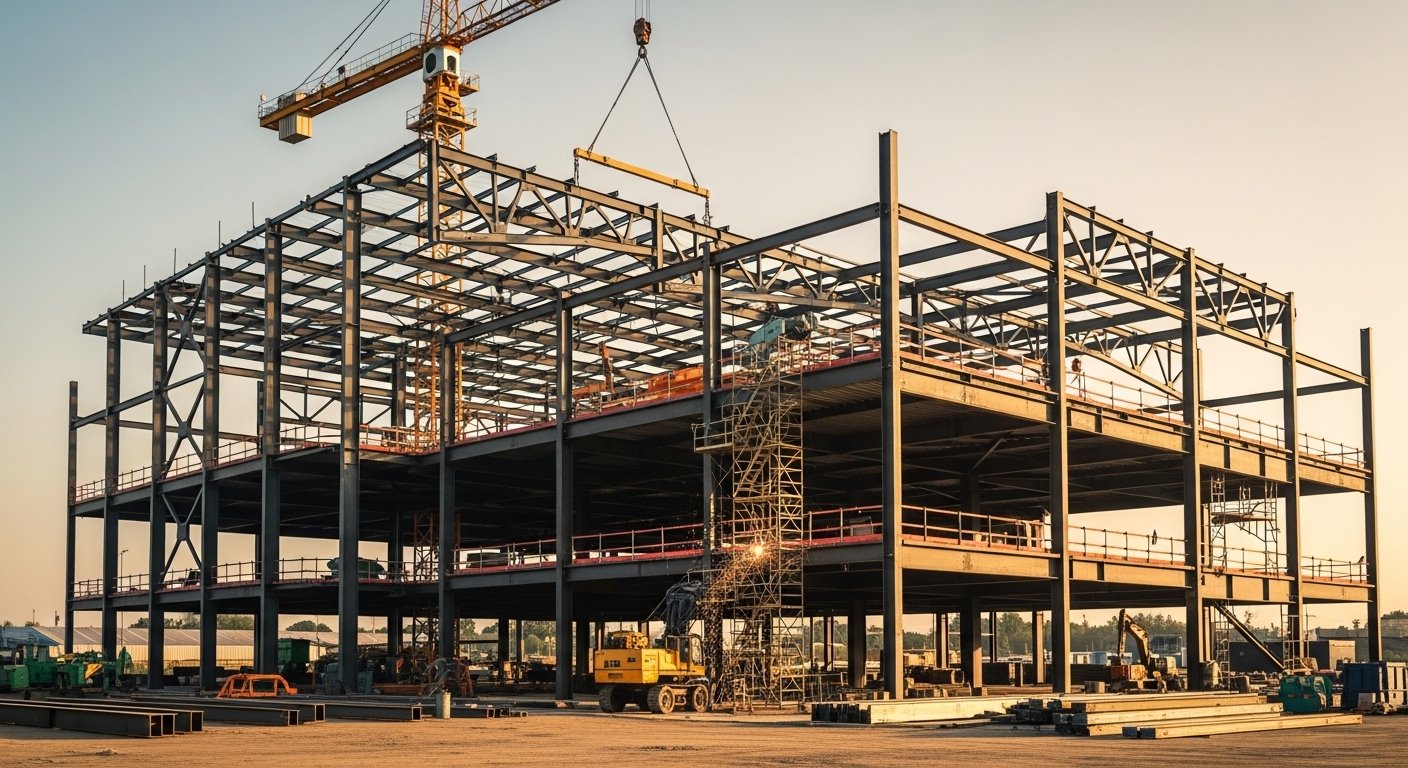
IS 800-aligned structural steel fabrication from Hyderabad, with mill-traceable material, qualified welding procedures, dimensional inspection and third-party inspection coordination when specified. Request Technical Proposal
Share enquiry drawings or an issued-for-construction steel schedule for scope confirmation and a technical proposal.
Key Fabricated Structural Elements
Industrial programmes rarely use only standard rolled beams. The workshop fabricates columns, beams, built-up sections, plate girders, trusses, pipe racks, equipment supports, conveyor structures and industrial structures for process plants, warehouses and infrastructure works.
Plate Girders
Plate girders are built-up flexural members with web and flange plates welded to form I or box sections for spans and loads beyond rolled beam catalogues. Used for crane runways, bridge approaches, long conveyor supports and heavy pipe bridges. Fabrication requires stiffener detailing, splice design and UT on main welds. See plate girder fabrication.
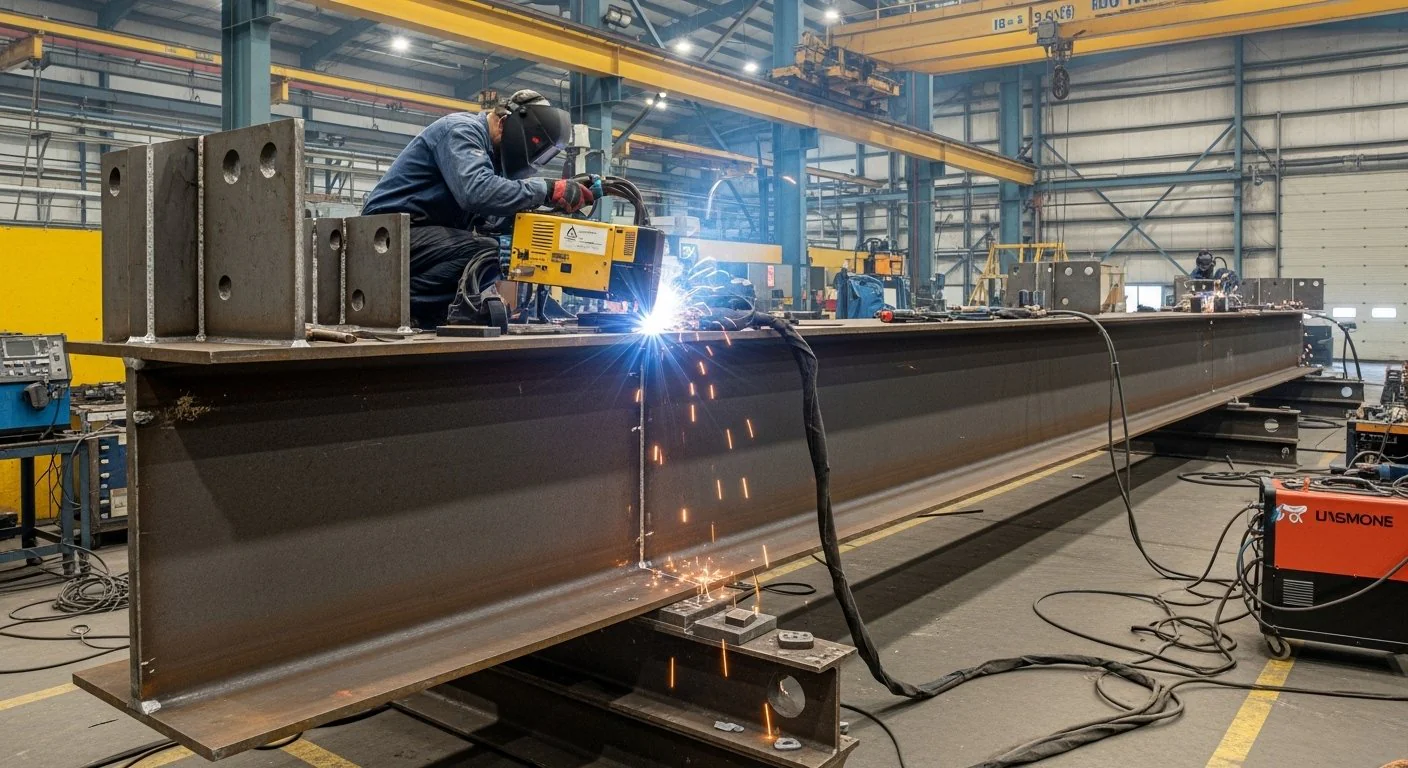
Built-Up Beams
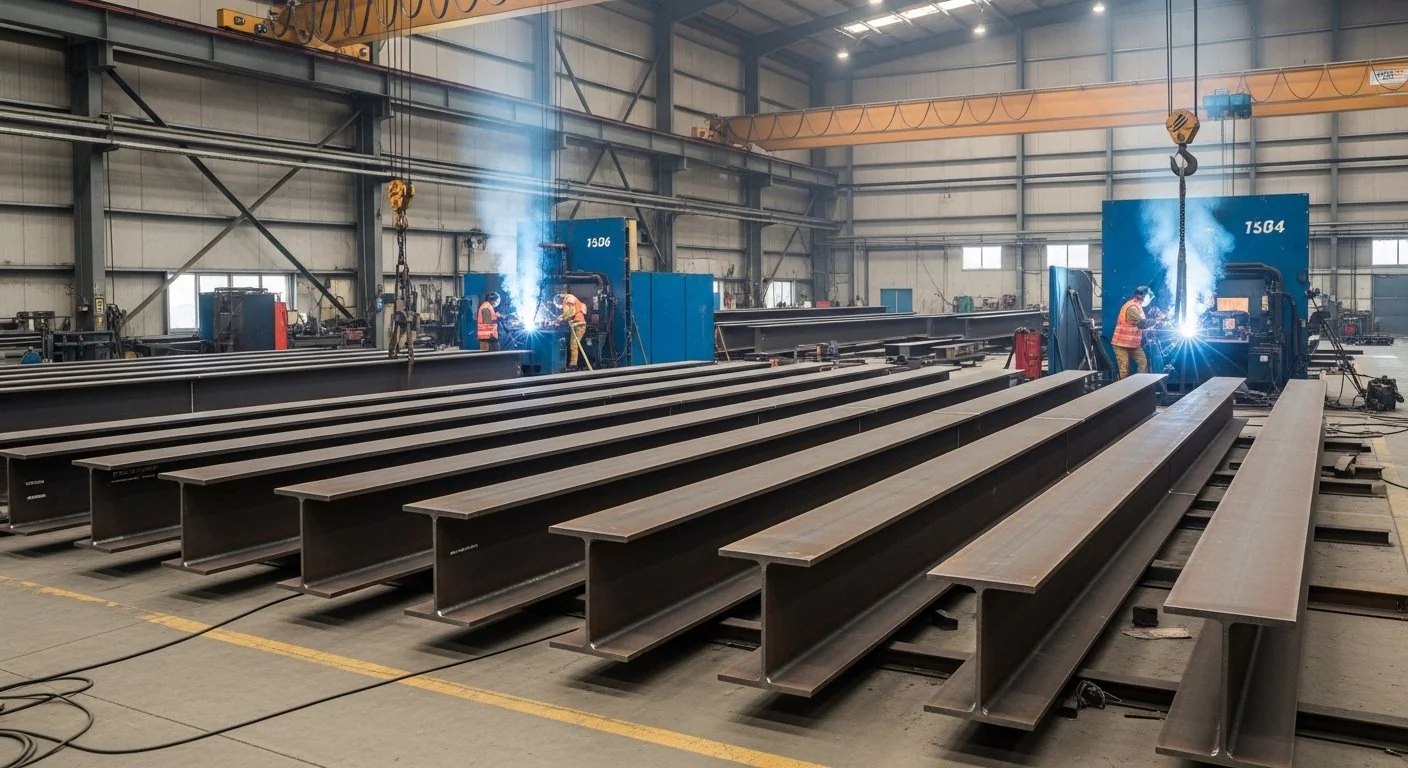
Built-up beams combine plates or welded channels into H-sections when required depth or moment capacity exceeds available rolled profiles. Common in industrial shed rafters, mezzanine girders and gantry crane supports. See built-up beam fabrication.
Built-Up Columns
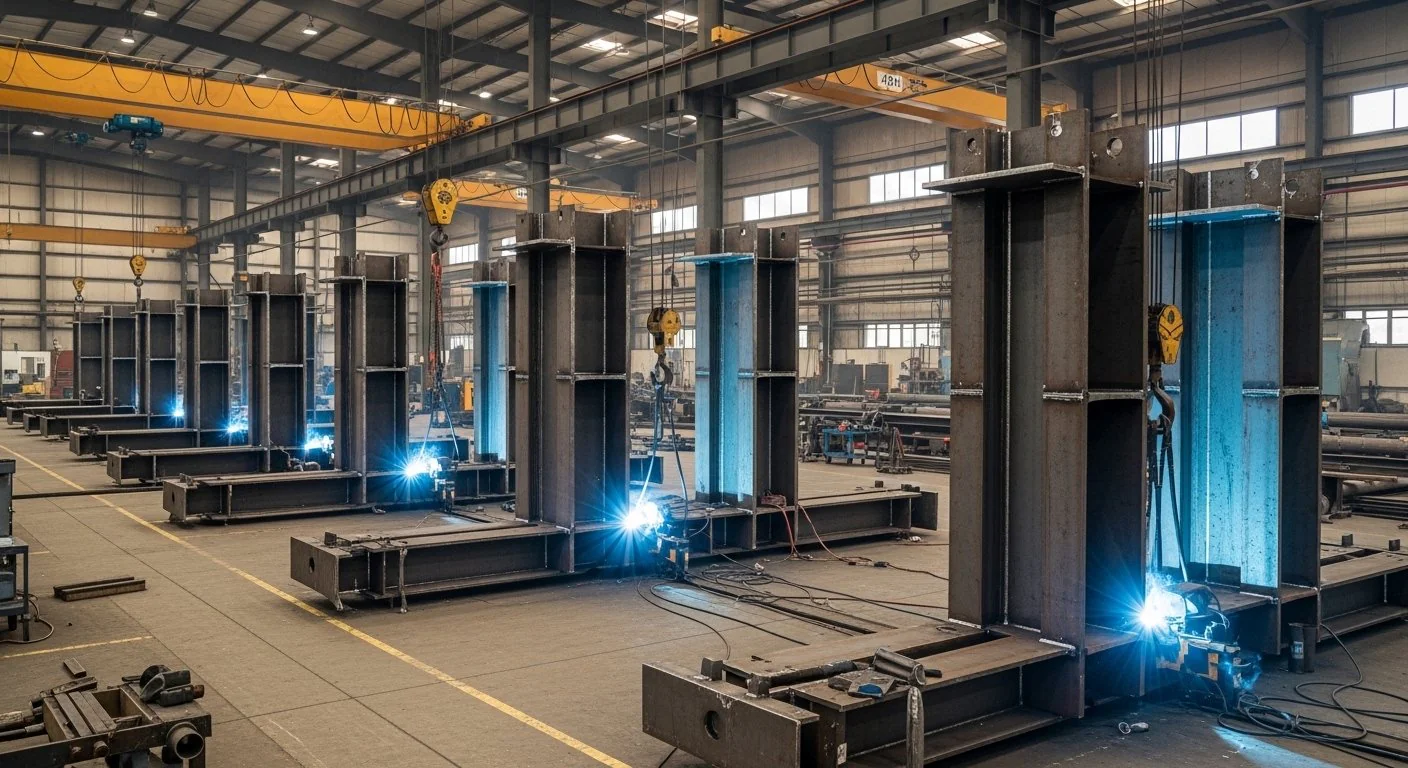
Built-up columns use welded plates or laced/battened assemblies for heavy axial loads and long unsupported lengths in pipe rack bents and process structures. Base plate and stiffener detailing is critical for moment transfer. See built-up column fabrication.
Steel Trusses
Steel trusses are triangulated frameworks for long-span roofs, conveyor covers and bridge superstructures. Shop fabrication focuses on gusset plate accuracy, member length tolerance and camber control. See Steel Truss Fabrication Guide.
Gantry Girders
Gantry girders support overhead gantry cranes in workshops and outdoor yards. Designed per IS 807 wheel loads with stiffened top flanges, rail mounting plates and fatigue-sensitive detail categories. Fabrication tolerances on rail level and span alignment govern crane operation.
Pipe Racks
Pipe racks are multi-tier steel frames carrying process and utility piping, cable trays and instruments across plant corridors. Tier widths, bent spacing and expansion joint locations must be resolved with piping stress before shop release. See pipe rack fabrication.
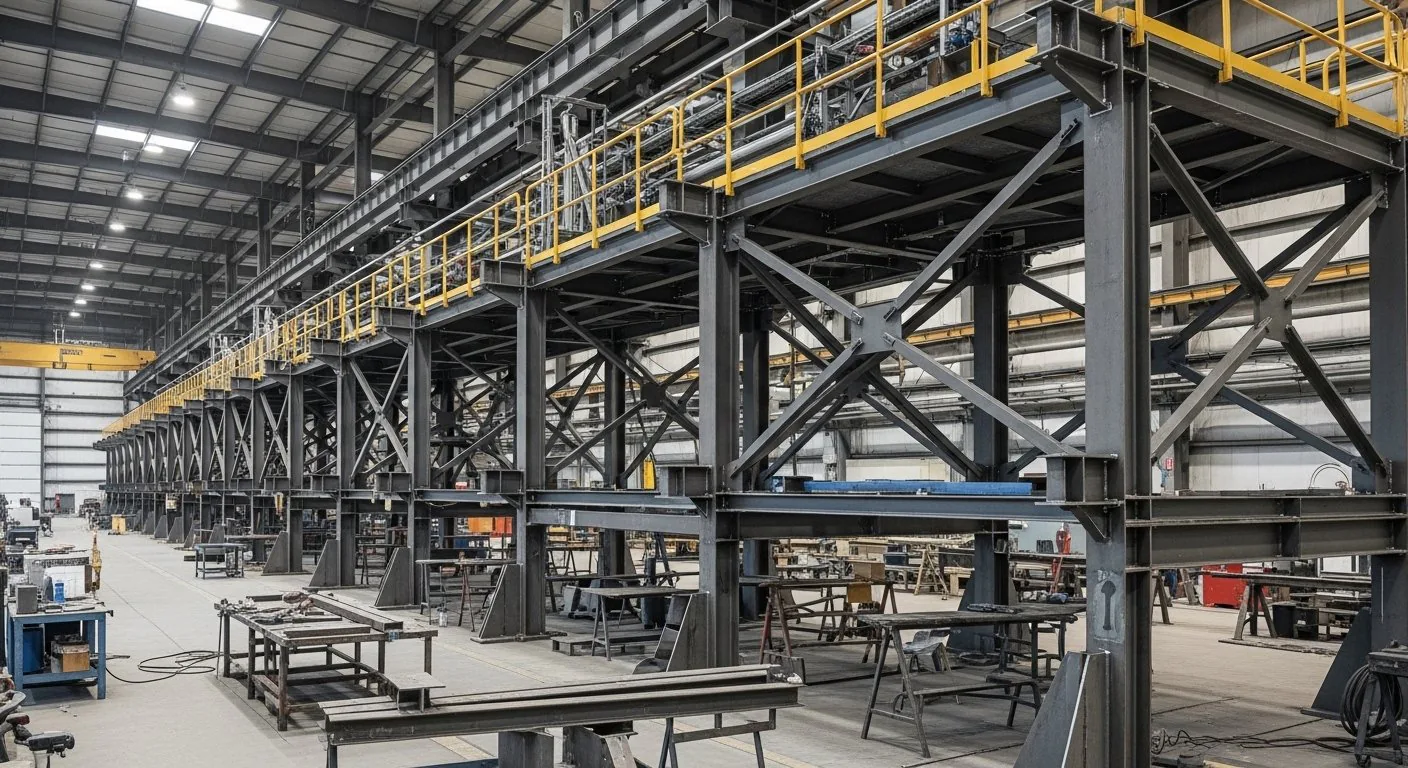
Plate Girder vs Rolled Beam
| Criteria | Plate Girder | Rolled Beam (ISMB/ISWB) |
|---|---|---|
| Span range | 12 m – 40 m+ | Typically ≤12 m economical |
| Depth control | Custom web depth | Fixed catalog depths |
| Fabrication | Shop welded; higher QC | Ready section; faster fab |
| Cost | Higher fab labour | Lower for light spans |
| Best for | Crane girders, bridges, heavy spans | Buildings, light platforms, secondary beams |
Built-Up Beam vs Standard Beam
| Criteria | Built-Up Beam | Standard Rolled Beam |
|---|---|---|
| Section availability | Any depth/width combination | Limited to mill catalogues |
| Moment capacity | High — custom flange thickness | Moderate |
| Lead time | Fabrication time + plate procurement | Stock sections faster |
| Welding | Web-to-flange welds + NDT | Mostly connection welds only |
| Typical use | PEB rafters, long spans, crane paths | Floor beams, bracing, light frames |
PEB vs Conventional Steel Construction
| Criteria | PEB Structures | Conventional Steel |
|---|---|---|
| Design approach | Optimised tapered sections; proprietary software | Hot-rolled sections; manual IS 800 design |
| Weight efficiency | Typically 15–25% lighter for sheds | Higher steel weight for same span |
| Erection speed | Fast — bolted standard connections | Varies; often heavier members |
| Flexibility | Best for uniform sheds, warehouses | Better for irregular geometry, heavy cranes |
| Cost drivers | Design repetition, high tonnage | Custom connections add detailing cost |
| Documentation | PEB supplier GA + anchor bolts | Full structural GA and shop drawings |
Read the full comparison in our PEB vs Conventional Steel Construction Guide and PEB structures product page.
Pipe Rack vs Conventional Support Structure
| Criteria | Pipe Rack | Conventional Support Frame |
|---|---|---|
| Function | Multi-tier corridor for piping and cables | Localised equipment or platform support |
| Loading | Piping weight, thermal movement, wind on pipes | Equipment dead/live loads |
| Geometry | Longitudinal tiers with repeated bents | Discrete frames at equipment locations |
| Coordination | Piping stress, civil foundations, electrical trays | Mechanical vendor interfaces |
| Fabrication | Modular bents; standardised tiers | Custom one-off connections |
Quick Answer
Structural steel fabrication is the controlled workshop process of cutting, fitting, welding and assembling IS 2062 steel into columns, beams, plate girders, trusses, pipe racks and industrial frames per IS 800:2007 shop drawings — with mill-traceable material, qualified welding procedures and inspection records accepted at project hold points before site erection.
Key Takeaways
- IS 800:2007 governs design and fabrication acceptance; IS 2062 defines steel grades; IS 875 defines dead, live and wind loads on structures.
- Industrial projects use E250 for standard frames, E350 for crane girders and heavy trusses, and E450 for high-stress or seismic zones.
- Plate girders, built-up beams and built-up columns are fabricated when rolled sections cannot meet span, depth or load requirements.
- Pipe racks, PEB structures and process plant steel require coordinated detailing, tier loads and interface hold points with piping and mechanical packages.
- Indicative fabrication cost in India ranges roughly ₹90–₹145 per kg (2026) depending on member complexity, NDT scope, coating and documentation depth.
- Quality acceptance depends on material traceability, WPS/PQR-backed welding, dimensional tolerances and indexed inspection dossiers.
- Suncorporation Fabricators & Engineers supplies IS 800-compliant fabrication and erection from Jeedimetla, Hyderabad for industrial and infrastructure programmes across India.
Industry Standards and Codes
Answer: Indian structural steel fabrication for industrial projects is governed primarily by IS 800:2007, IS 2062, IS 875, IS 7215 and welding standards IS 816 — supplemented by project-specific licensor requirements.
Standards Reference Table
| Standard | Title / Scope | Application in Fabrication |
|---|---|---|
| IS 800:2007 | General construction in steel — Code of practice | Design basis, connections, fabrication tolerances, inspection |
| IS 2062:2011 | Hot rolled structural steel | Material grades E250, E350, E450; MTC requirements |
| IS 875 (Parts 1–3) | Design loads on buildings | Dead, live, wind load combinations in design |
| IS 816 | Metal arc welding of structural steel | WPS, welder qualification, acceptance criteria |
| IS 9595 | Metal arc welding — Recommendations | Supplementary welding guidance |
| IS 1367 | Technical supply conditions for fasteners | Structural bolts, nuts, washers |
| IS 807 | EOT crane code of practice | Crane runway and gantry girder design loads |
| IS 1893 | Earthquake resistant design | Seismic load combinations and detailing |
Standards and Compliance
IS 2062 specifies chemical composition, mechanical properties and supply conditions for hot rolled structural steel. Every consignment must ship with mill test certificates linking heat numbers to grade — steel without that traceability is rejected.
IS 800:2007 is the governing design and fabrication code for general steel construction in India. It defines limit state design, connection categories, fabrication tolerances and inspection expectations. Read our IS 800 Guide for clause-level procurement reference.
IS 875 provides imposed, dead and wind load values used by structural engineers in building and rack design. See our IS 875 loads guide for part-by-part reference on dead, live and wind loads. Fabricators do not calculate primary loads but must fabricate to the member sizes and connections shown on drawings prepared using these load cases.
Welding standards: WPS and PQR qualification per IS 816; welder performance records maintained per project. AWS D1.1 may be invoked on export or dual-code contracts.
Fabrication tolerances: Length, hole position, camber and sweep per IS 800 and project shop drawings — typically ±2 mm on bolt pitch and defined camber offsets on girders.
IS 7215 — fabrication tolerances
IS 7215 is the Indian Standard covering permissible tolerances for fabrication of steel structures. It is used with approved shop drawings to control member length, straightness, camber, sweep and hole position before dispatch. Dimensional inspection after fit-up and welding checks that fabricated members remain within those limits so site erection can proceed without field rework.
IS 800:2007 Annex F also sets fabrication tolerances, and Annex G sets erection tolerances. Project specifications may invoke IS 7215, the IS 800 annexes, or both. QA/QC records — fit-up reports, weld maps and dimensional inspection reports — are the workshop evidence that tolerances have been applied. This is a fabrication-tolerance reference, not a certification claim.
Material traceability: Heat numbers marked on members or tags; MTCs indexed in dispatch dossiers.
Quality documentation: Shop drawing register, weld maps, NDT reports, dimensional records, coating logs and dispatch challans — formatted for licensor and third-party submittal.
Manufacturing Process
Answer: Fabrication follows a sequenced workflow from drawing approval through cutting, welding, inspection, coating and marked dispatch — each step generating records for inspection dossiers.
- Drawing review & GA approval — shop drawings submitted from IFC; piece marks and splice locations locked
- Material procurement — IS 2062 steel from SAIL, JSPL, Tata Steel with MTC verification
- CNC cutting & drilling — plasma/oxy-fuel cutting; CNC drilling to bolt hole tolerances
- Fit-up & welding — jig alignment; SAW on long built-up seams; SMAW/FCAW on positional welds per IS 816
- NDT — UT on full-penetration butts; MPI/DPT on fillets; RT through NABL labs when specified
- Surface treatment — shot blasting Sa 2.5; primer, intermediate and top coat per spec
- Dimensional inspection — camber, sweep, hole pitch, length tolerance vs shop drawing
- Dispatch & erection handover — piece-mark lists, challans, erection marks; site bolt-up by own or contractor crews
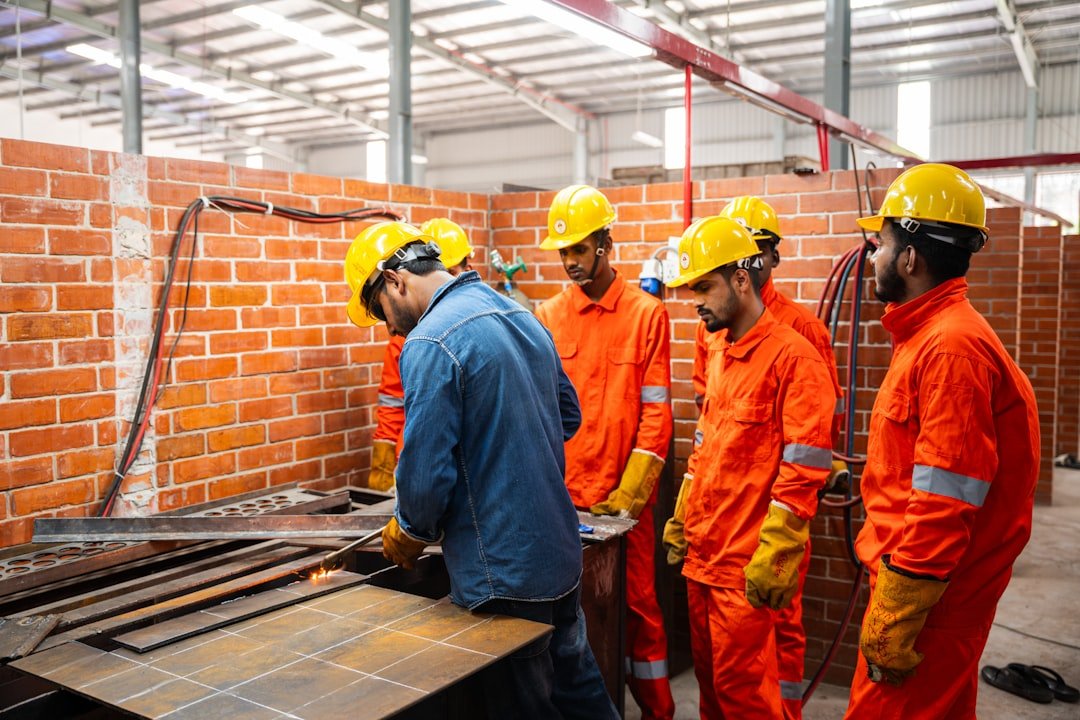
Applications of Structural Steel Fabrication
Answer: Fabricated steel structures serve every sector where speed, span, modularity or industrial load intensity favour steel over in-situ concrete.
- Process plant structures — pipe racks, equipment supports, technological platforms, pipe bridges
- Industrial buildings — factory sheds, warehouse steel structures, crane bays, mezzanine floors
- PEB structures — pre-engineered portal frames and secondary systems for logistics and manufacturing
- Infrastructure — metro stations, airport terminals, bridges, ROB superstructures
- Material handling — conveyor gallery structures, transfer towers, gantry crane supports
- Heavy industrial fabrication — plate girders, built-up columns, steel trusses over long spans
- Stadium and sports venues — grandstand roof trusses, terrace raker frames, floodlight mast structures, indoor arena roofs
- Marine and port structures — port building frames, conveyor trestle structures, quayside crane rail beams, jetty superstructure steel
- Multi-storey buildings — commercial office frames, SMRF connections for seismic zones, transfer trusses
Suncorporation executes fabrication and erection across these categories from enquiry drawings through inspection documentation submittals. Product-specific scope is detailed on our Products Hub and linked structure pages below.
Industry Applications
Answer: Suncorporation supplies fabricated steel structures across heavy industry, logistics, infrastructure and process sectors — as defined-scope fabrication and erection, not turnkey process or equipment supply.
Cement Plants
Conveyor galleries, transfer towers, kiln/preheater support steel, mill building crane runways and utility pipe racks. See cement plant structures.
Steel Plants
Rolling mill building frames, melt shop structures, material handling galleries and crane girders. See steel plant structures.
Refineries & Petrochemical
Process pipe racks, pipe bridges, equipment supports and technological structures. See refinery steel structures.
Power Plants
Boiler support structures, coal handling galleries, turbine building steel and auxiliary pipe racks.
Warehouses & Logistics Parks
PEB and conventional portal frames, mezzanine floors, dock canopies and crane bays for distribution centres.
Data Centers
Structural frames for equipment halls, roof steel and support platforms for MEP coordination.
Manufacturing Plants
Factory building structures, equipment support structures, industrial platform structures and access steel.
Infrastructure Projects
Metro station steel, airport structures, bridges and pedestrian FOB frameworks on infrastructure packages.
Project Experience
Representative programmes include L&T Metro Rail Hyderabad station steel (850 MT), GMR Airport Hyderabad expansion terminal steel (620 MT), IKEA Hyderabad warehouse frames (480 MT) and industrial pipe rack packages for process plants. Experience spans fabrication-only supply and fabricate-and-erect contracts with pan-India dispatch.
Metro Project
- Structural steel fabrication
- Hyderabad
- Infrastructure sector
Airport Project
- Terminal steel fabrication
- Industrial construction
Industrial Project
- Warehouse steel fabrication
- Heavy structural steel
Quality Control and Inspection
Answer: QC verifies material identity, weld integrity, dimensions and coating before dispatch — aligned to the project inspection test plan (ITP).
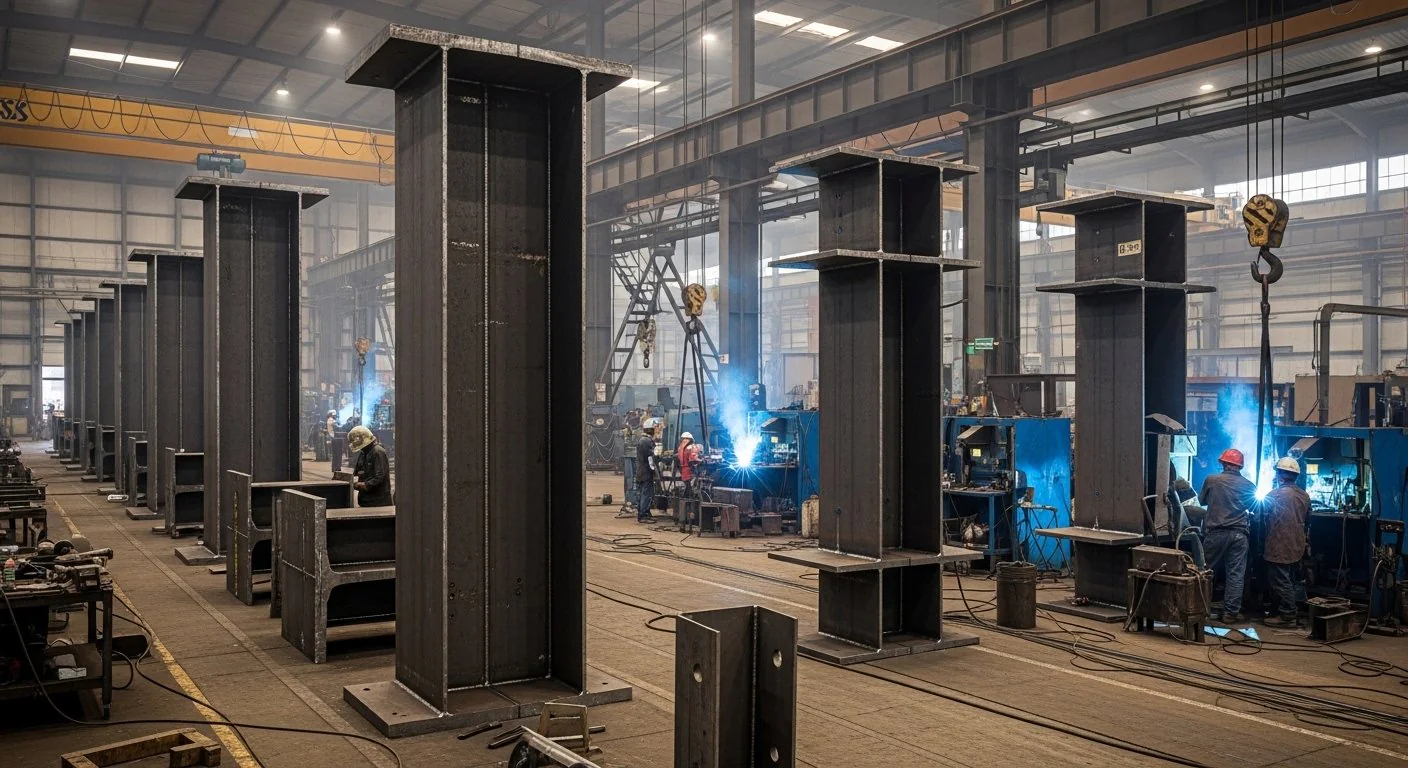
Quality Control Parameters Table
| Stage | Check | Method / Record |
|---|---|---|
| Material receipt | Grade, heat number, MTC match | Visual + MTC review; PMI if specified |
| Cutting | Length, edge quality | Steel type; cutting plan traceability |
| Fit-up | Gap, alignment, root opening | Fit-up inspection report |
| Welding | WPS compliance, visual weld profile | Welder IDs; weld map |
| NDT | Internal discontinuities | UT / RT / MPI / DPT per ITP |
| Dimensions | Camber, sweep, hole pitch | Dimensional inspection report |
| Coating | DFT, adhesion, cleanliness | DFT gauge logs; blast profile |
| Dispatch | Piece mark, packing, damage check | Dispatch challan + mark list |
Inspection Requirements Table
| Inspection Type | Applicable To | Typical Standard / Acceptance |
|---|---|---|
| Visual welding inspection | All welds | IS 816; project WPS |
| Ultrasonic testing (UT) | Full-penetration butt welds | IS 1608; 100% on critical joints |
| Radiography (RT) | Specified pressure or licensor joints | ASME / client spec via NABL lab |
| Magnetic particle (MPI) | Fillet welds, crane connections | IS 3703 |
| Dye penetrant (DPT) | Non-magnetic materials, tie plates | IS 3650 |
| Dimensional survey | All dispatched members | Shop drawing tolerances |
| Third-party witness | EPC hold points | ITP stage release |
Manufacturing Capability
Suncorporation Fabricators & Engineers operates from Plot No. 36, Road No. 80, Phase V, Jeedimetla Industrial Estate, Hyderabad. Workshop equipment includes CNC plasma cutting (12 m bed), CNC drill lines, submerged arc welding sets, 20 T overhead cranes, shot blast room (Sa 2.5) and paint bay with DFT monitoring. Monthly throughput exceeds 500 MT across columns, beams, plate girders, built-up sections, pipe racks, trusses and PEB structures. In-house NDT covers UT, MPI and DPT; NABL-accredited RT is arranged for third-party hold points.
Verified Manufacturing Capabilities
- Structural Steel Fabrication
- fabricated steel beams
- fabricated steel columns
- fabricated plate girders
- industrial pipe racks
- Industrial structures and related fabricated steel (see products overview)
- Material traceability with mill test certificates (IS 2062)
- Inspection documentation for tender and handover dossiers
For workshop credentials and documentation format, see Manufacturer Credentials. For indicative rates, see Structural Steel Fabrication Cost per KG.
Quality Assurance Process
QA is structured around project ITPs: material receipt inspection → cutting release → fit-up approval → welding with WPS ID traceability → NDT per joint category → dimensional sign-off → coating inspection → final dispatch release. Non-conforming members are quarantined until rework or documented concession. Indexed PDF dossiers are issued aligned to drawing numbers and piece marks.
Material Traceability
Every plate and section is logged against mill heat number, grade and MTC reference before marking for cutting. Dispatch tags carry piece mark, heat number and weight. This supports material control registers and licensor audits on process plant and infrastructure packages.
Inspection and Testing
Inspection scope scales with structure criticality — warehouse secondary steel may require visual and dimensional checks only, while crane girders and process rack nodes carry UT on full-penetration welds and third-party witness at hold points. Test reports reference joint IDs from weld maps for unambiguous traceability.
What is Structural Steel Fabrication?
Structural steel fabrication is the workshop conversion of procured steel sections and plates into finished structural members — cut to length, drilled, fitted, welded, inspected, surface-treated and marked for erection — according to approved shop drawings derived from the structural engineer’s design. It is distinct from structural steel design (analysis and member sizing per IS 800:2007) and from site erection (assembly of dispatched members onto foundations). A structural steel fabrication company in India typically covers shop drawing preparation or review, material procurement with mill test certificates, CNC cutting, fit-up, welding to qualified WPS, non-destructive testing, blasting and painting, dimensional inspection and dispatch documentation indexed to piece marks.
Structural steel designs in India are typically developed in accordance with IS 800:2007 and loading requirements specified in the IS 875 Structural Design Loads Guide — dead, live and wind load cases that govern member sizing before steel reaches the fabrication workshop.
Fabrication quality determines whether steel arrives on site within tolerance, passes hold-point inspection and bolts up without field rework. Poor fabrication — incorrect hole patterns, inadequate weld profiles, missing stiffeners or untraceable material — delays erection programmes regardless of design adequacy on paper.
Why is Structural Steel Fabrication Important?
Answer: Fabrication is the quality gate between structural design and a safe, erectable structure on site — errors at this stage cannot be corrected economically after dispatch.
On industrial and infrastructure projects, structural steel often represents 15–35% of civil and structural package value and sits on the critical path between foundation readiness and mechanical installation. Industrial steel programmes depend on the fabrication workshop to:
- Release steel in lots aligned with site crane and access windows
- Supply weld maps, NDT reports and MTCs for licensor and third-party review
- Fabricate built-up members, plate girders and rack frames that rolled-section suppliers cannot provide as finished assemblies
- Maintain dimensional tolerances on splice connections that govern erection speed
For process plants, refinery expansions and warehouse programmes, choosing an experienced structural steel manufacturer India with documented IS 800:2007 systems reduces rework, supports prequalification for future tenders and protects programme float.
Benefits of Structural Steel Fabrication
Answer: Controlled workshop fabrication delivers predictable quality, faster site programmes and design flexibility for industrial spans and loads.
- Speed: Parallel fabrication while civil works progress; site erection by bolting pre-fabricated modules
- Quality control: Welding, NDT and dimensional checks in a controlled workshop environment
- Span capability: Plate girders, trusses and built-up sections achieve spans impractical in concrete
- Modularity: Pipe racks and galleries dispatched in logical erection sequences
- Traceability: Heat-number-linked MTCs support material control registers
- Adaptability: Custom connections and stiffening for equipment and crane interfaces
Factors Affecting Structural Steel Fabrication
Answer: Cost, schedule and quality outcomes depend on drawing completeness, member complexity, steel grade, coating, NDT depth and documentation requirements — not raw material price alone.
Cost Factors Table (Indicative — India 2026)
| Factor | Impact on Cost | Typical Range / Note |
|---|---|---|
| Member type | Primary driver | Simple rolled sections lowest; built-up and plate girders higher |
| Steel grade | Material premium | E350/E450 plate ~8–18% above E250 for same section |
| Welding & NDT scope | Labour + testing | Full-penetration butt welds with UT/RT add ₹12–₹35/kg |
| Surface treatment | Coating system | HDG or multi-coat paint adds ₹15–₹40/kg |
| Detailing origin | Shop drawing effort | Client-supplied IFC vs fabricator detailing |
| Tonnage | Economies of scale | <50 MT packages carry higher ₹/kg |
| Documentation | QA overhead | Licensor witness points and third-party RT increase cost |
| Location & logistics | Dispatch | Oversize girders need escort and special trailers |
Indicative structural steel fabrication cost per kg for workshop fabrication only (ex-works Hyderabad): ₹90–₹145/kg in 2026 for industrial packages. Final rates require drawing review. For full-scope contracts (design coordination through site erection), costs are commonly quoted per metric tonne instead — roughly ₹75,000–₹1,60,000/MT in 2026 depending on section complexity, inspection depth and painting specification. See our Structural Steel Fabrication Cost Guide for estimation methodology.
Design Considerations
Answer: Fabrication-ready design under IS 800:2007 accounts for load combinations per IS 875, connection ductility, erection staging and member split lines for transport.
These parameters should be confirmed before shop drawing release:
- Load combinations — dead, live, wind (IS 875 Parts 1–3) and crane loads (IS 807 where applicable)
- Deflection limits for crane girders, gantry girders and long-span trusses
- Connection type — bolted bearing, friction grip or welded splices — and access for site bolting
- Splice locations aligned with transport limits and site crane radius
- Corrosion environment — paint system, HDG or weathering steel (Fe410W)
- Seismic zone detailing per IS 1893 for moment frames and braced frames
Structural steel detailing translates GA and design outputs into piece-marked shop drawings with weld symbols, bolt lists, stiffener schedules and assembly marks. Detailing errors are the most common cause of fabrication rework — IFC revisions should be locked before cutting release. Read our Structural Steel Detailing Guide for submittal workflow.
Design Parameters Table
| Parameter | Standard / Reference | Typical Application |
|---|---|---|
| Design code | IS 800:2007 | All structural steel design and fabrication acceptance |
| Dead loads | IS 875 Part 1 | Self-weight, cladding, equipment dead load |
| Live loads | IS 875 Part 2 | Platforms, roofs, maintenance access |
| Wind loads | IS 875 Part 3 | Buildings, racks, galleries, tall frames |
| Crane loads | IS 807 | EOT crane runway and gantry girders |
| Seismic | IS 1893 | Zone III/IV industrial and institutional frames |
| Deflection limits | IS 800 Table 5 (serviceability) | Spans, cranes, sensitive equipment supports |
| Connections | IS 800 Section 10 | Bolted and welded joint design |
Material Selection Criteria
Answer: Select IS 2062 grade based on stress level, temperature, exposure and connection requirements — E250 for general frames, E350 for heavy industrial members, E450 for high-stress or seismic applications.
Material Comparison Table — IS 2062 E250 vs E350 vs E450
| Grade | Yield Strength (min) | UTS (min) | Typical Use | Notes |
|---|---|---|---|---|
| IS 2062 E250 (Fe410) | 250 MPa | 410 MPa | Columns, beams, bracing, standard pipe racks, PEB secondary | Most common industrial grade; BR/BO/AR supply conditions |
| IS 2062 E350 (Fe490) | 350 MPa | 490 MPa | Plate girders, crane girders, heavy trusses, built-up columns | Reduces section weight; tighter welding QC expected |
| IS 2062 E450 (Fe570) | 450 MPa | 570 MPa | High-stress frames, seismic zones, heavy equipment supports | Higher preheat and NDT attention on coded welds |
Note: Older specifications and market literature sometimes reference “Fe410” or “E410” in conversation — in current IS 2062:2011 nomenclature, Fe410 corresponds to the E250 grade family. See our IS 2062 Steel Grades Guide.
Material Specifications Table
| Product Form | Standard | Grades Supplied | Supply Condition |
|---|---|---|---|
| Hot rolled sections (ISMB, ISMC, ISA, etc.) | IS 2062:2011 | E250, E350, E450 | BR / BO per drawing |
| Plates and flats | IS 2062:2011 | E250, E350, E450 | UT tested plate where specified |
| High-strength bolts | IS 1367 (parts) / IS 3757 | Property Class 4.6, 8.8, 10.9 | With manufacturer test certs |
| Welding consumables | IS 814 / IS 7280 | Matching electrode/wire for base metal | Batch certificates logged |
Mechanical Properties Table (IS 2062 — Representative)
| Grade | Yield (MPa) | UTS (MPa) | Elongation (%) | Impact (optional) |
|---|---|---|---|---|
| E250 BR | 250 | 410 | 23 (thickness ≤20 mm) | 27J at 0°C when specified |
| E350 BR | 350 | 490 | 22 | 27J at 0°C when specified |
| E450 BR | 450 | 570 | 20 | 27J at 0°C when specified |
Chemical Composition Table (IS 2062 — Max % unless noted)
| Element | E250 | E350 | E450 |
|---|---|---|---|
| Carbon (C) | 0.22 | 0.20 | 0.20 |
| Manganese (Mn) | 1.50 | 1.55 | 1.60 |
| Sulphur (S) | 0.045 | 0.040 | 0.035 |
| Phosphorus (P) | 0.045 | 0.040 | 0.035 |
Common Mistakes
Answer: Most fabrication disputes trace to incomplete drawings, grade mismatches, skipped hold points or unclear scope boundaries — not to steel price negotiation.
- Releasing cutting before IFC shop drawing approval
- Procuring steel without verified MTCs or wrong supply condition (BR vs BO)
- Under-specifying NDT on crane girders and moment connections
- Ignoring transport split lines — members fabricated too long for road dispatch
- Mixing PEB anchor bolt sets with conventional base plate details
- Omitting stiffeners and doubler plates shown on connection details
- Quoting fabrication without coating system, tonnage band or documentation depth
Why Choose Sun Corporation
- IS 800 compliant manufacturing: Fabrication aligned to IS 800:2007 acceptance expectations for industrial steel packages.
- Material traceability: IS 2062 supply with mill test certificate and heat-number control.
- QA/QC inspections: ITP-based checks across material, fit-up, welding, NDT, dimensions, coating, and dispatch.
- Inspection documentation: Weld maps, NDT reports, dimensional records, and indexed handover dossiers.
- Pan India execution: Fabrication from Hyderabad with multi-state project support.
- Experienced engineers: Shop drawing review and fabrication release control for industrial steel packages.
- Reliable delivery: Piece-marked, erection-oriented dispatch planning.
- Technical proposal assistance: Drawing/BOQ review support via contact page.
Industries Served
Defined structural steel scope from approved drawings — fabrication and erection for manufacturing plants, process plants, warehouses and infrastructure. Not turnkey process or equipment supply.
Quick Specification Table
| Item | Specification |
|---|---|
| Design code | IS 800:2007 |
| Material | IS 2062 E250 / E350 / E450 |
| Loads (design basis) | IS 875 Parts 1–3; IS 807 for cranes |
| Welding | IS 816 qualified WPS/PQR |
| Surface prep | Sa 2.5 shot blast; paint or HDG per spec |
| Capacity | 500+ MT/month (Hyderabad workshop) |
| Service area | Pan-India fabrication and erection |
| Documentation | MTCs, weld maps, NDT, dimensional reports |
Technical Data Table
| Parameter | Value |
|---|---|
| Cutting tolerance | ±1 mm (CNC plasma/oxy-fuel) |
| Bolt hole tolerance | Per IS 800 / connection design |
| Typical fabrication cost | ₹90–₹145/kg ex-works (2026 indicative) |
| Portal clear span capability | Up to ~40 m (conventional/PEB) |
| Plate thickness range | 6 mm – 50 mm+ (heavier on review) |
| Coating DFT | Per paint system — typically 120–280 µm total |
Related Technical Guides & Products
Frequently Asked Questions
What is IS 2062 steel?
IS 2062 is the Indian Standard for hot rolled structural steel specifying grades E250, E350 and E450 with defined yield strength, chemical composition and mechanical properties. It is the primary material specification for structural steel fabrication in India. Mill test certificates must confirm grade and heat number for every consignment.
What is structural steel fabrication?
Structural steel fabrication is the workshop process of converting IS 2062 sections and plates into finished structural members — cut, drilled, welded, inspected, coated and marked per IS 800:2007 shop drawings for site erection. It includes material traceability, qualified welding and inspection documentation.
What is structural steel fabrication cost per kg?
Indicative structural steel fabrication cost per kg in India for 2026 ranges approximately ₹90–₹145/kg ex-works for workshop fabrication only, depending on member complexity, steel grade, NDT scope, coating and documentation. Material cost is additional. See our cost guide for breakdown.
What is IS 800:2007?
IS 800:2007 is the Indian code of practice for general construction in steel using limit state design. It governs member design, connections, fabrication tolerances and inspection requirements for industrial and building structures. It is the mandatory reference for structural steel packages in India.
What is a plate girder?
A plate girder is a built-up I or box section fabricated from steel plates welded together, used when rolled beams cannot provide required span or load capacity — common in crane runways, bridges and long conveyor supports. See welded plate girders.
What is a built-up beam?
A built-up beam is a fabricated H-section assembled from plates or welded components rather than a single rolled section, allowing custom depth and flange thickness for industrial rafters, mezzanine girders and heavy spans.
What is a built-up column?
A built-up column is a fabricated compression member — typically welded plates or laced components — designed for heavy axial loads in pipe rack bents, process structures and tall industrial frames where rolled columns are insufficient.
What is a steel truss?
A steel truss is a triangulated framework of chords and web members used for long-span roofs, bridges and conveyor covers. Fabrication accuracy on gusset plates and member lengths controls erection fit and design performance.
What is a gantry girder?
A gantry girder is a horizontal crane support beam carrying wheel loads from overhead gantry cranes, designed per IS 807 with stiffened flanges and rail mounting details. Fabrication tolerances on span and level are critical for crane operation.
What is a pipe rack?
A pipe rack is a multi-tier structural steel frame supporting process and utility piping, cable trays and instruments across plant corridors. It is a core process plant structure requiring coordination with piping stress before fabrication release.
What steel grade is used for industrial structures?
IS 2062 E250 is standard for columns, beams and bracing. E350 is used for crane girders, plate girders and heavy trusses. E450 applies to high-stress or seismic applications. Grade selection follows IS 800 design output.
What are PEB structures?
PEB structures (pre-engineered buildings) are factory-designed portal frame systems using tapered built-up sections optimised for warehouses and industrial sheds — faster erection and lighter steel than conventional hot-rolled framing for uniform spans.
What is the difference between E250 and E350?
E250 has minimum yield 250 MPa (Fe410 steel type); E350 has minimum yield 350 MPa (Fe490). E350 allows lighter sections for the same load but requires stricter welding and inspection. E250 is economical for general industrial frames.
What standards apply to structural steel fabrication?
Primary standards: IS 800:2007 (design and fabrication), IS 2062 (material), IS 875 (loads), IS 816 (welding). Project specs may add IS 807, IS 1893, IRC:24 or licensor requirements.
How is structural steel quality inspected?
Through material MTC verification, fit-up and visual weld inspection, NDT (UT/RT/MPI/DPT) per ITP, dimensional checks against shop drawings, coating DFT measurement and documented dispatch release — with third-party witness at project hold points when required.
Request a Technical Proposal
Share enquiry drawings or steel BOQ for scope confirmation and a technical proposal.
Workshop scope also covers fabricated crane beams, shed and warehouse steel, elevated conveyor steel, and skid and equipment steel. Sector releases for steel plant frames, cement works steel frames, and refinery and petrochemical steel use the same IS 800 fabrication regime.
Share enquiry drawings, IFC drawings or a steel BOQ for scope confirmation, capacity alignment and a technical fabrication proposal. Suncorporation Fabricators & Engineers supplies structural steel fabrication, steel fabrication and erection and inspection documentation for site acceptance. See also structural steel fabricators in India.
Roof steel and canopy packages — including fabricated trusses — are often released with the same shed or building steel order.