
High rise steel building fabrication in India — multi-storey structural steel for offices, industry and residential
Steel frames for multi-storey buildings in India are not a niche market anymore. The combination of shorter construction programmes, better weight management on urban sites, and the expanding availability of skilled steel erection teams has made high rise steel building fabrication increasingly competitive with RCC construction for commercial offices, industrial multi-storey structures, and mixed-use developments. Suncorporation has been fabricating and erecting multi-storey structural steel frames for over two decades, across building heights from five floors to twenty-five floors, in Hyderabad and at sites across India.
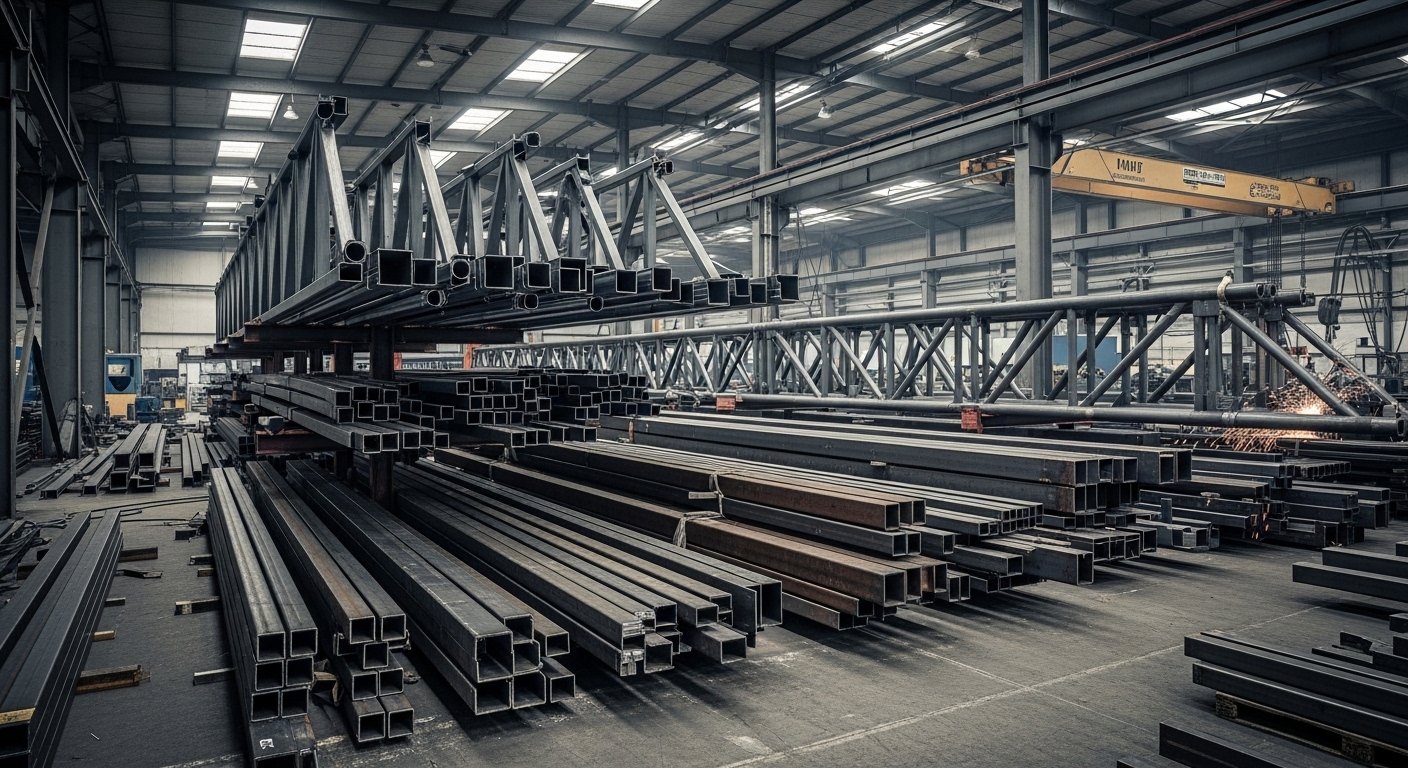
This page covers what high rise steel building fabrication involves — the structural systems, the IS standards, the seismic design requirements that apply across much of India, and what the process looks like from drawings to a completed frame. It also covers costs, timelines, and what separates a steel fabricator who can reliably deliver a multi-storey project from one who cannot.
Why steel for high rise buildings in India
Programme speed is the most significant advantage. A steel frame for a ten-storey commercial building can be erected in six to ten weeks once fabrication is complete. The equivalent RCC frame — pour, cure, strip, repeat for each floor — takes four to six months. For commercial developers on tight lease commitments, or for industrial clients who need their facility operational by a specific date, that programme advantage is worth paying for.
Weight is the second major advantage. A steel frame for a ten-storey building weighs roughly 40 to 60 percent less than a comparable RCC frame. On urban infill sites in Mumbai, Hyderabad, or Bengaluru — where foundation costs are high — reducing the superstructure weight materially reduces the foundation cost. The saving on foundations often offsets most or all of the premium cost of steel over RCC for the superstructure. The third advantage is flexibility — a steel frame can be modified in ways that an RCC frame fundamentally cannot.
The structural system for high rise steel building fabrication in India
Columns
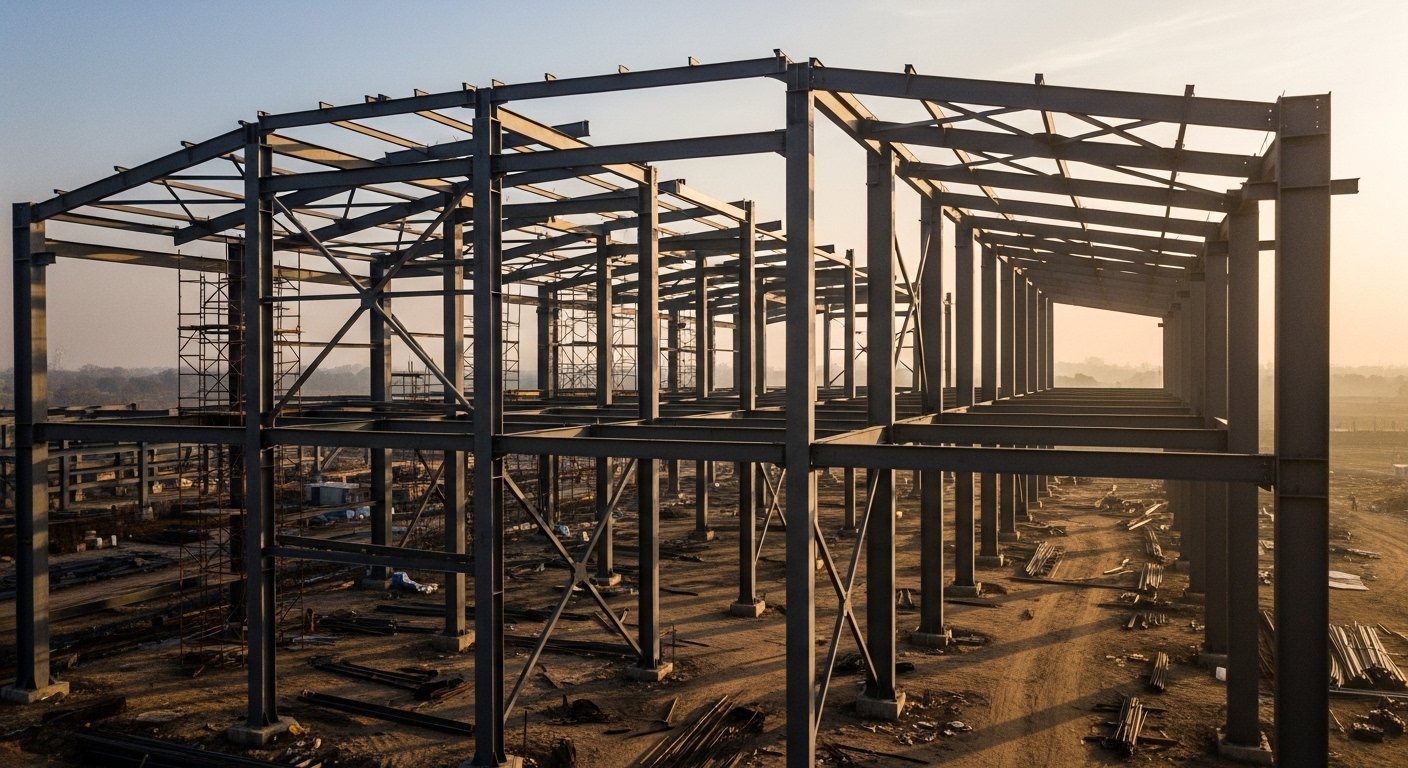
High rise steel columns in India are typically fabricated from universal column sections for buildings up to about 12 stories, and from welded box sections or compound columns for taller buildings where the axial loads exceed what hot-rolled UC sections can carry economically. Column splices — connecting one column length to the next, typically at every second or third floor — are critical details. For seismic applications the splice needs to be capable of transmitting tension as well as compression, which typically means full-penetration butt welds on the flanges rather than bearing splice plates.
Beams, floor steel and transfer trusses
Floor beams in high rise steel building fabrication are typically universal beams in the primary grid, with secondary beams spanning between them at closer centres to carry the floor deck. For composite slab construction — the most common floor system for steel-framed buildings in India — shear studs are welded to the top flange of the primary and secondary beams to create composite action with the concrete slab. Transfer trusses — where columns are discontinued at podium levels — can be 1.5 to 3 metres deep and span 12 to 20 metres. They are among the most technically demanding elements in high rise steel building fabrication.
Seismic design and SMRF connections in high rise steel building fabrication
India’s seismic zonation map places most of the country in zones II to V. For high rise steel buildings in zones III and above, IS 1893:2016 requires special moment-resisting frames — SMRFs — that provide the ductility to absorb seismic energy without collapse. SMRF beam-column connections require continuity plates inside the column opposite the beam flanges, doubler plates where the column web is insufficient, and specific weld details at the beam flange-to-column flange connection validated by testing. At Suncorporation, SMRF connections are fabricated with UT inspection of all full-penetration welds and MPI of the continuity plate and doubler plate fillet welds.
The high rise steel building fabrication process at Suncorporation
The process starts when we receive the issued-for-construction structural drawings and the connection design. Shop drawings are prepared by our drafting team — these contain the fabrication-level information not included in structural drawings: precise dimensions of each fabricated element, weld sizes and lengths, bolt hole patterns, piece marks, erection weights, and lifting point locations. Material is procured from approved mills against the IS 2062 material specification. Fabrication follows the approved shop drawings, and dispatch is managed against the erection sequence — high rise steel building fabrication produces large numbers of individual elements, and getting them to site in the right order for the crane programme is as important as fabricating them correctly.
High rise steel building fabrication cost in India — 2026
- Standard commercial frame, zones II to III, 5 to 12 floors: Rs 85,000 to Rs 1,05,000 per MT fabricated and erected, including primer painting and connections.
- Commercial frame with SMRF connections, zones III to IV, 5 to 15 floors: Rs 1,00,000 to Rs 1,25,000 per MT fabricated and erected.
- Frame with transfer trusses, any zone: Rs 1,20,000 to Rs 1,60,000 per MT for the transfer truss elements; standard floor steel at the standard rate.
- Industrial multi-storey structure with crane provisions: Rs 1,10,000 to Rs 1,40,000 per MT depending on crane capacity.
High rise steel building fabrication timeline
- Shop drawing preparation and approval: 4 to 6 weeks. Two rounds of comments from the structural engineer are typical.
- Steel procurement: 3 to 5 weeks from order placement to delivery at the workshop.
- Fabrication: 10 to 16 weeks for 500 to 900 MT of multi-storey steel.
- Erection: 8 to 14 weeks for a ten-storey frame with a crew of 20 to 25 erectors.
- Total from IFC drawings to erection completion: 22 to 32 weeks for a project in this size range.
Getting a quotation for high rise steel building fabrication
To get a reliable fabrication and erection quotation for a high rise steel building project, the minimum information we need is: the structural drawings at any stage from scheme to IFC, the building location and seismic zone, the floor-by-floor use of the building, and an indication of any special structural elements such as transfer trusses or heavy crane provisions. We respond to all high rise steel building fabrication enquiries within 24 hours.
Contact Suncorporation for high rise steel building fabrication. Also see: Airport steel fabrication | Crane girder fabrication | Industrial shed fabrication | Structural steel Hyderabad