
Airport Steel Structure Fabrication for Terminals, Hangars and Airside Buildings
Live airport sites impose constraints that do not exist on a greenfield industrial project — airside access permits, FOD controls, night erection windows, and documentation standards that aviation authorities enforce without exception. Airport steel structure fabrication in India must account for those constraints from the drawing stage, not after steel arrives on site. Sun Corporation Fabricators & Engineers fabricates terminal frames, hangar structures, car park steel, and airside support buildings at our Hyderabad workshop to IS 800:2007, with AAI specification requirements addressed at prequalification. Project documentation for EPC and aviation PMC teams is available via our manufacturer credentials for EPC tender review.
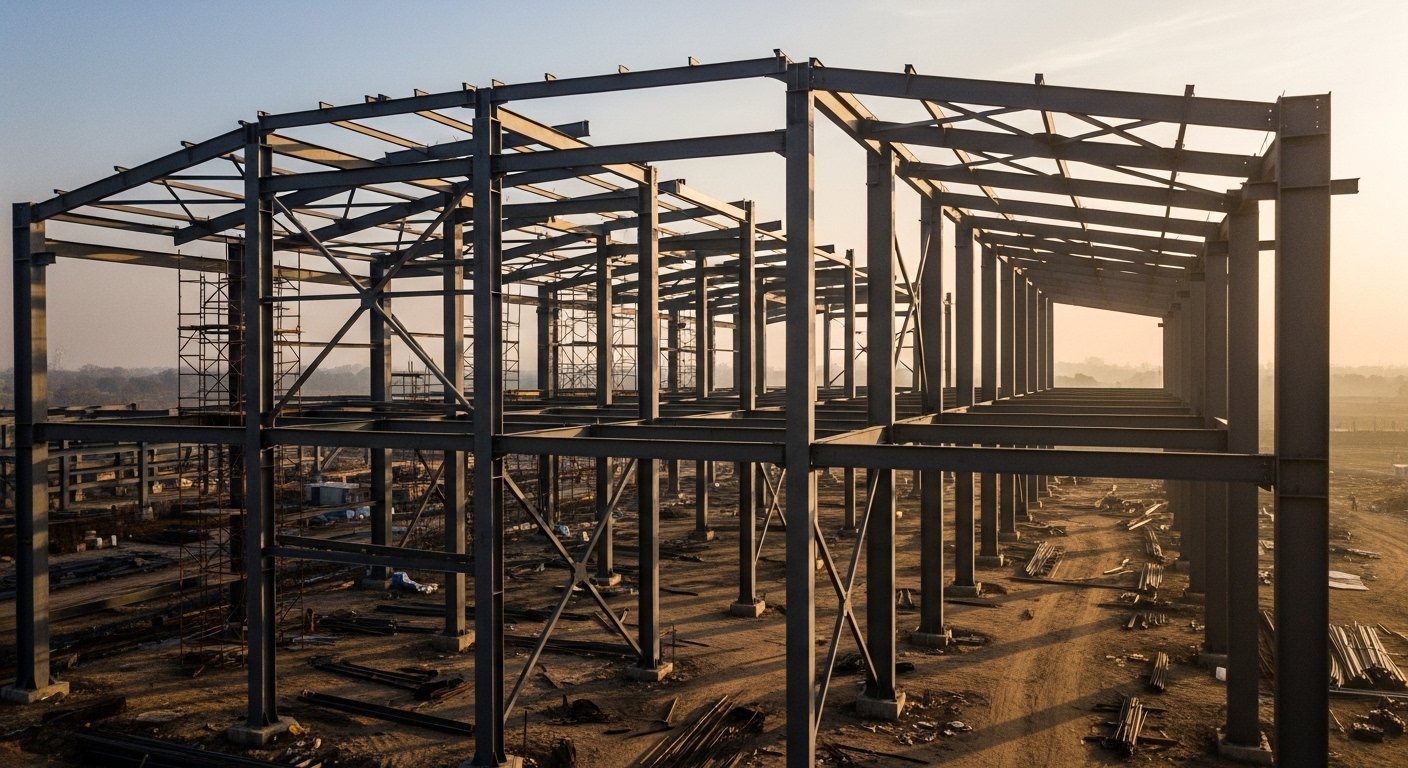
This page covers what airport steel structure fabrication actually involves in the Indian context — the IS standards that apply, the typical project types we handle and what the process looks like from drawing receipt to handover. If you have a set of drawings and need a quote, the fastest route is to send them to us directly.
What we fabricate for airports
Airport steel structure fabrication is not a single product — it is a family of related structural steel packages that together form the skeleton of an airport. The most visible is the terminal building itself: the long-span roof that arcs over departure halls and arrival concourses, the primary column and beam frame that carries multiple levels of passenger circulation, the transfer trusses that span over open spaces on the ground floor. These are big, complex steel structures. A domestic terminal at a Tier-2 Indian airport might use 600 to 1,200 MT of structural steel. A new international terminal at a major hub can exceed 4,000 MT.
Beyond the terminal itself, airport projects typically require steelwork for aircraft hangars, multi-storey car parks, airside fuel farm structures, apron lighting masts, covered walkways, sky bridges between terminals, and a range of smaller support structures scattered across the airside and landside. All of this comes under the broader umbrella of airport steel structure fabrication, and all of it needs to meet the same quality and documentation standards as the main terminal frame.
Terminal structural frames
The primary steel frame of an airport terminal is typically a combination of heavy built-up columns and long-span beams or transfer trusses that carry the upper floors and roof. The column grid for a multi-level terminal is designed to allow free movement of passengers on the concourse below, which means column spacings of 12 to 20 metres are common. All terminal structural steel from Sun Corporation is designed and fabricated to IS 800:2007. For terminals in seismic zones III, IV, or V — which covers most of South and West India — connection design follows IS 1893:2016 requirements for special moment-resisting frames.
Long-span roof trusses and space frames
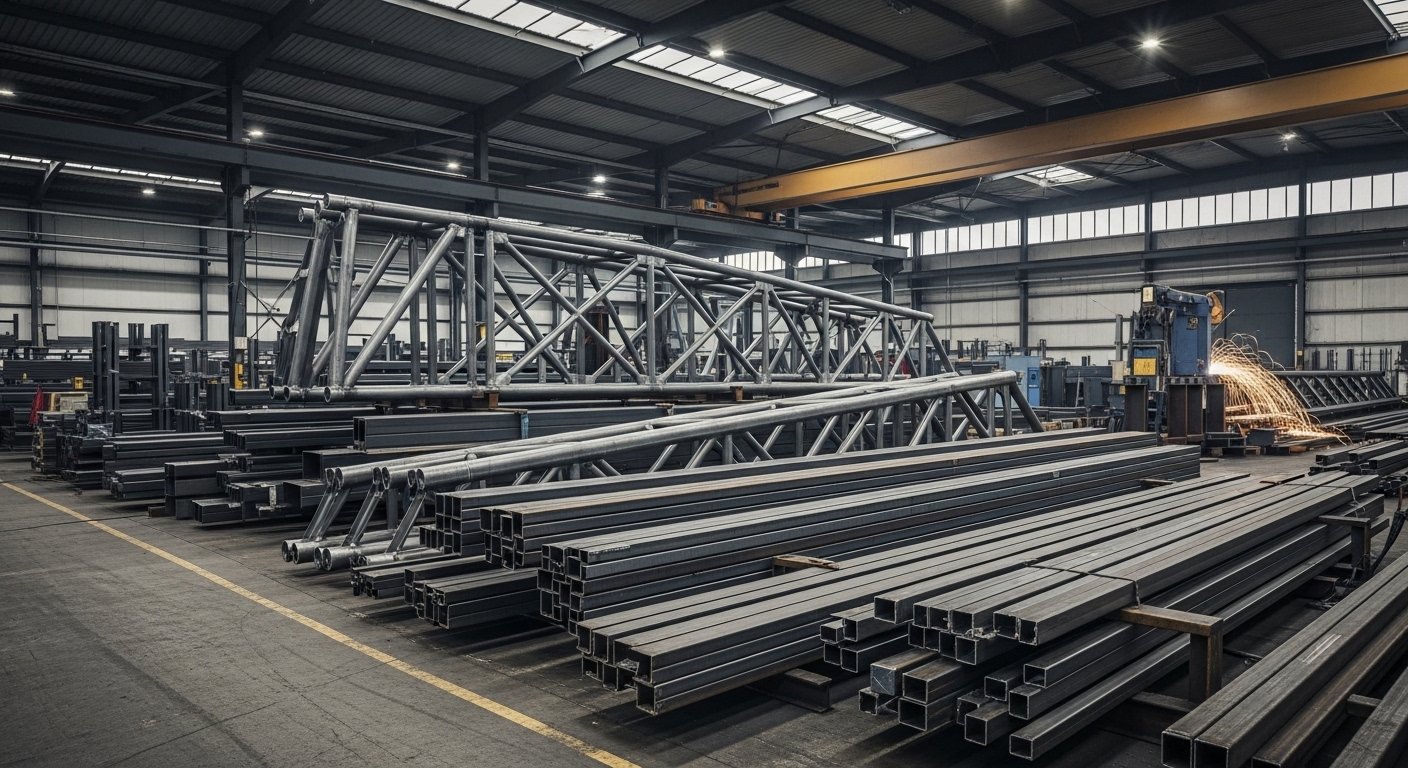
Indian airport terminals built or expanded since 2010 typically use long-span steel roof trusses, space frames, or a combination of both, spanning 40 to 100 metres to create the clear, column-free covered spaces that passengers experience below. Fabricating these structures is not the same as fabricating a standard industrial portal frame. The joint geometry is complex, the tolerances on the truss depth and chord alignment are tight, and the surface finish requirements are higher because the steel is often exposed to view from below. At Sun Corporation, all airport roof truss steel is pre-assembled in our workshop before dispatch to confirm geometry and bolt hole alignment before the steel reaches site.
Aircraft hangars
An aircraft hangar is a very large clear-span structure — column-free bays of 40 to 80 metres to accommodate the wing span and tail height of the aircraft being maintained. Sun Corporation has fabricated aircraft hangar steel for MRO operators, airlines, and defence clients. We handle both PEB-compatible frame designs and conventional welded plate frame designs for wider spans or heavier crane loads. The choice between the two usually comes down to span, crane capacity, and the client’s preference for flexibility in future modifications.
Airside infrastructure and support structures
Beyond the main terminal and hangars, airports require a substantial amount of support steelwork — fuel farm tank saddle supports, apron lighting mast shafts typically 20 to 35 metres tall, elevated walkway structures between buildings, ground services equipment shelters, and perimeter fencing structural frames. For all of this, the documentation requirements are the same as for the main terminal steel. Every piece needs material test certificates traceable to the IS 2062 plate or section it was made from, and every weld needs to be made to a qualified procedure.
Multi-level car parks
Airport landside car parks in India are increasingly being built in steel rather than RCC — primarily because the construction programme is shorter, the dead load on the substructure is lighter, and future modification or expansion is much easier. A five-level steel car park takes around 12 to 16 weeks from fabrication start to erection completion, compared to 20 to 28 weeks for a comparable RCC structure. Sun Corporation fabricates multi-level car park steel to NBC 2016 and IS 800:2007, handling the full package — columns, beams, vehicular ramp framing, and sky bridge connections to the terminal.
Codes we work to
- IS 800:2007 — the main structural steel design code. All airport structural steel in India references this document.
- IS 875 Parts 1, 2 and 3 — dead loads, imposed loads, and wind loads. Wind loading is critical for airport terminal and hangar structures.
- IS 1893:2016 — seismic design. Most major Indian airports are in seismic zones where IS 1893 governs connection design for the primary frame.
- IS 2062 — the material standard for hot-rolled steel in India. All structural steel plates and sections used in airport projects are procured to IS 2062 with mill test certificates.
- IS 9595 — weld procedure qualification. Every weld category used on airport steel needs a qualified WPS backed by a PQR.
- NBC 2016 — National Building Code. Structural fire resistance requirements for airport terminal steel.
- AAI Technical Specifications — Airport Authority of India project-specific requirements covering structural performance, surface finish, and inspection protocols.
How we deliver airport steel
The process starts when we receive the issued-for-construction structural drawings and the material specification. Our production team reviews the drawings, raises RFIs on connection details or ambiguities before fabrication begins, and prepares the material requisition from the approved IFC drawings. Steel is procured from approved Indian mills with IS 2062 mill test certificates, inspected on receipt, and tagged with heat numbers for traceability. Inspection during fabrication covers dimensional checks at each stage, NDT by our in-house team and third-party agencies as required, and painting inspection records compiled into a quality dossier that accompanies every structural element.
Working on live airport sites
On a live airport, access to the site passes through airside security. Personnel need AVSEC clearances. Vehicles need permits. FOD — Foreign Object Debris — is a serious safety concern, and every fastener, every off-cut, every piece of packing material that enters the airside needs to be documented and removed. Night erection windows are common on live airport projects — work on structures adjacent to operational runways or taxiways is typically restricted to periods when air traffic is minimal, usually between midnight and 5am. Our site teams are experienced in working night shifts, planning the day’s material and equipment preparation so that the erection window is used efficiently from the moment it opens.
Airport steel questions we are often asked
Airport terminal steel tonnage — what is typical for Indian projects?
Airport terminal steel tonnage for domestic terminal buildings in India typically falls between 500 MT and 2,000 MT. International terminals and multi-level integrated terminal complexes exceed 5,000 MT. Sun Corporation handles airport steel packages from 200 MT to 3,000 MT under a single fabrication and erection contract.
Airport steel fabrication timeline — how long does it take?
Airport steel fabrication lead time from drawing approval runs 14 to 22 weeks for a typical terminal package. Aircraft hangar fabrication runs 10 to 16 weeks. Sun Corporation can begin fabrication within 3 to 4 weeks of order placement when drawings are approved.
Airport steel erection in live environments — can Sun Corporation work airside?
Airport steel erection in live environments is standard for Sun Corporation. Our teams operate under airside access permits, prepare FOD control plans, work within approved erection windows, and submit method statements and risk assessments before mobilisation.
Airport steel fabrication cities — where does Sun Corporation deliver?
Airport steel fabrication is delivered across India — Hyderabad, Mumbai, Delhi NCR, Bengaluru, Chennai, Kolkata, Ahmedabad, Pune, Nagpur, Visakhapatnam, and Tier-2 airport cities. Steel is fabricated in Hyderabad and transported to site; erection teams mobilise from Hyderabad to any Indian airport.
Airport steel structure fabrication enquiries — send your structural drawings to Sun Corporation for a quotation within 24 hours. Contact us | High rise steel | Crane girder fabrication | ROB construction | Industrial shed fabrication