
Steel girder fabrication in India — plate girders and box girders for bridges, buildings and cranes
A steel girder is a fabricated structural member that carries load primarily in bending — the top flange in compression, the bottom flange in tension, and the web in shear. It is the workhorse of Indian structural steel for any application where standard hot-rolled sections are not deep enough or heavy enough to carry the required loads over the required span. Bridges, crane runway beams, transfer structures in buildings, heavy industrial platforms — all of these use fabricated steel girders. Suncorporation has been fabricating plate girders and box girders for these applications across India for over two decades.
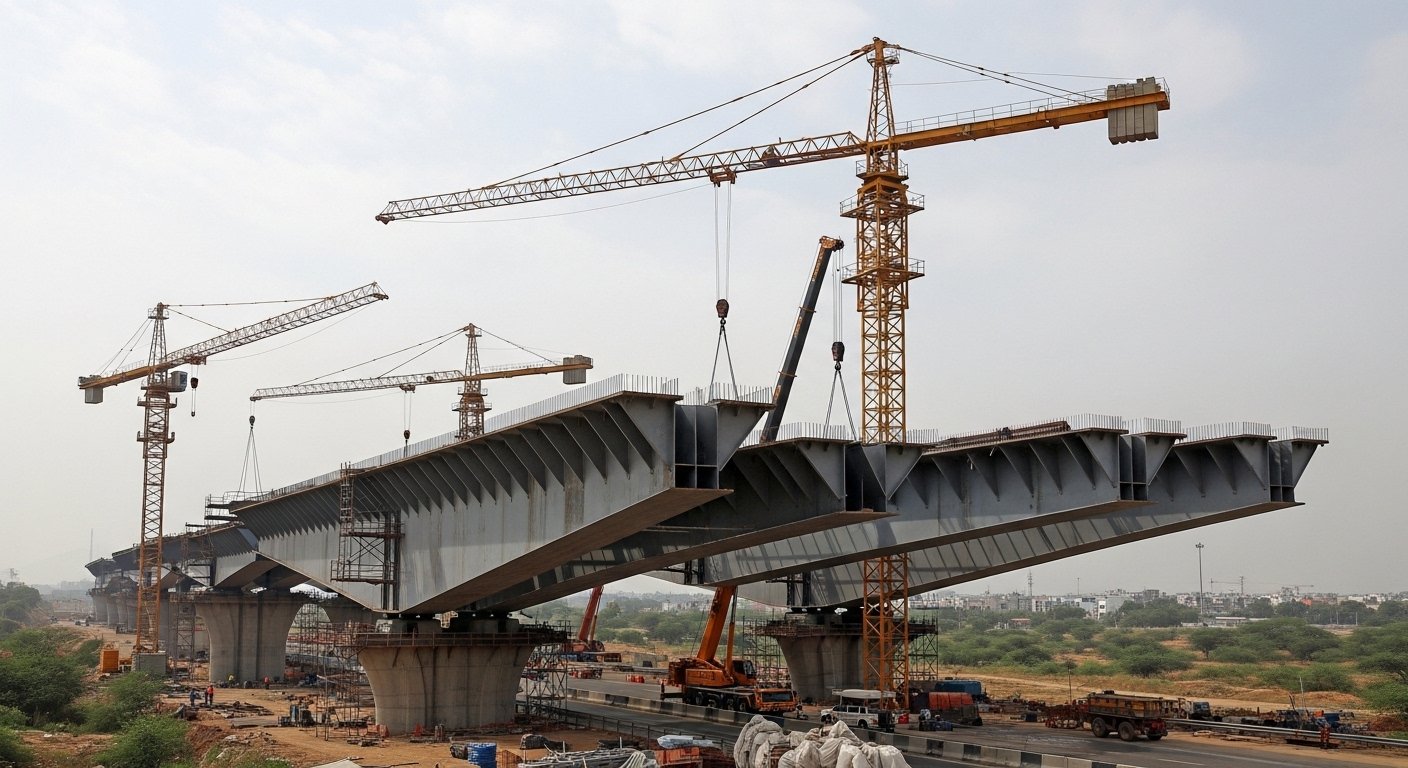
Plate girders — the most common product in steel girder fabrication
A plate girder is a fabricated I-section — top flange plate, web plate, and bottom flange plate, welded together — with vertical stiffener plates added to the web at regular intervals to prevent the web from buckling under shear. The dimensions can be specified freely rather than being constrained to the standard section sizes available in hot-rolled form. For a bridge crossing with a specified navigation clearance below and a road level above, the available depth for the girder might be exactly 1,650mm — too deep for the deepest standard UB section but manageable with a fabricated plate girder. For a crane runway beam where the top flange needs to be wider than standard to accommodate the crane rail, a fabricated plate girder with a 300mm top flange can be specified where no standard section exists.
Fabrication sequence and camber setting
Steel girder fabrication at Suncorporation starts with CNC plasma cutting of web and flange plates, assembly in a dedicated jig, and welding using SAW for heavy sections or MIG for lighter ones. Every crane girder needs positive camber — the minimum camber as L/1000 where L is the span between support points, per IS 807:2006 for crane runway beams. For bridge plate girders, camber is specified by the structural engineer as a profile. Camber is set during fabrication, verified by survey before painting, and recorded in the quality dossier that accompanies every girder to site.
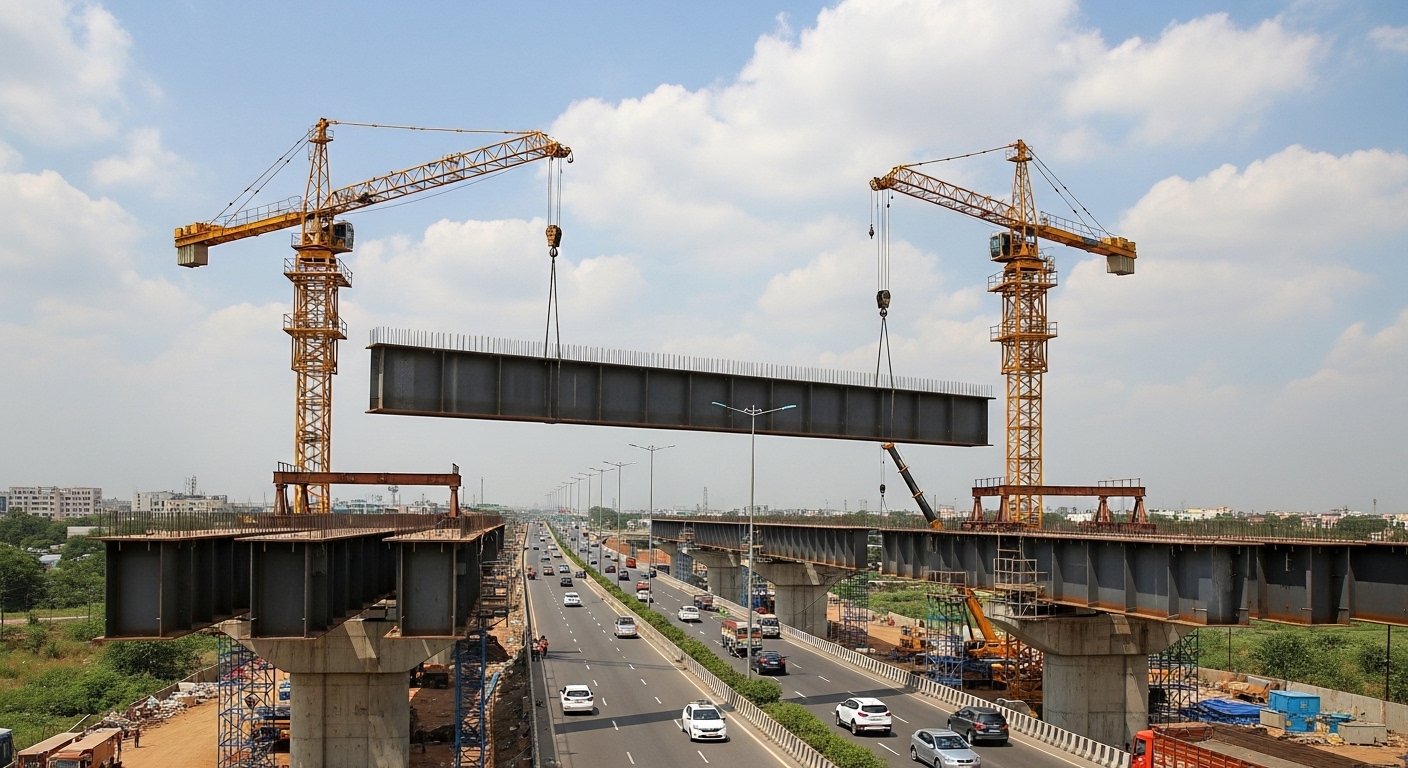
Box girders — when a plate girder is not enough
A box girder adds a second web plate to the plate girder cross-section, creating a closed rectangular or trapezoidal section. The closed section has dramatically higher torsional stiffness than an equivalent open I-section — a property that matters whenever the girder is subject to torsional loading or needs to carry load applied eccentrically to the shear centre. Box girder steel fabrication is used for pedestrian bridges where the closed section provides torsional stiffness against eccentric pedestrian loading, for heavily loaded crane runway beams in wide-span bays, and for long-span road bridges where the aerodynamic stability of the cross-section matters.
Steel girder fabrication for ROB bridges
Road over bridge (ROB) construction is one of the largest markets for plate girder fabrication in India. Steel girder fabrication for ROB plate girders follows IRS B1-2001: IS 2062 bridge grade steel with Charpy impact testing; full-penetration longitudinal welds inspected by UT; IRS two-coat painting system on a shot-blasted surface; dimensional tolerances to IRS B1 including web straightness, camber profile, and bolt hole positions; and a quality dossier covering material certificates, weld inspection records, dimensional inspection records, and painting records. A typical ROB main span plate girder is 30 to 40 metres long, 1.5 to 2.2 metres deep, and weighs 40 to 80 MT per girder.
Steel girder fabrication cost in India — 2026
- Structural plate girder, IS 800, standard inspection, 600 to 1200mm depth: Rs 85,000 to Rs 1,05,000 per MT ex-workshop, fabricated and primed.
- ROB bridge plate girder, IRS B1, UT and MPI, 1200 to 2500mm depth: Rs 95,000 to Rs 1,20,000 per MT ex-workshop, fabricated and painted to IRS specification.
- Crane runway beam plate girder, IS 807, UT and MPI: Rs 1,05,000 to Rs 1,45,000 per MT ex-workshop depending on crane capacity and web plate thickness.
- Box girder, IS 800, standard inspection: Rs 1,05,000 to Rs 1,30,000 per MT ex-workshop.
- Transfer girder, heavy section, full NDT: Rs 1,20,000 to Rs 1,60,000 per MT ex-workshop.
Enquiries for steel girder fabrication
To get a quotation for steel girder fabrication from Suncorporation, we need the structural drawing showing the girder cross-section and profile, the span, the material specification, the inspection category, and the painting specification. For ROB girders, the IRS specification number and required inspection agency are useful. For crane runway beams, the crane wheel load data from the crane supplier and the IS 807 crane class are needed. We respond to all steel girder fabrication enquiries within 24 hours.
Contact Suncorporation for steel girder fabrication. Also see: ROB construction | Crane girder fabrication | Heavy steel fabrication | Pedestrian bridge fabrication