
Pre-engineered buildings India — PEB warehouse, factory and industrial shed fabrication
Pre-engineered buildings in India — the structural steel systems that have transformed industrial and warehouse construction over the last two decades — are not a single product. PEB is a design and fabrication approach: primary frames are computer-optimised as tapered I-sections, secondary members are cold-formed purlins and girts, and the entire package arrives on site as a numbered kit ready to bolt together. For straightforward rectangular buildings — warehouses, factories, logistics centres — PEB is genuinely the most economical structural system available in India. Suncorporation fabricates and erects pre-engineered buildings across India, from our own workshop in Hyderabad, with our own certified erection teams.
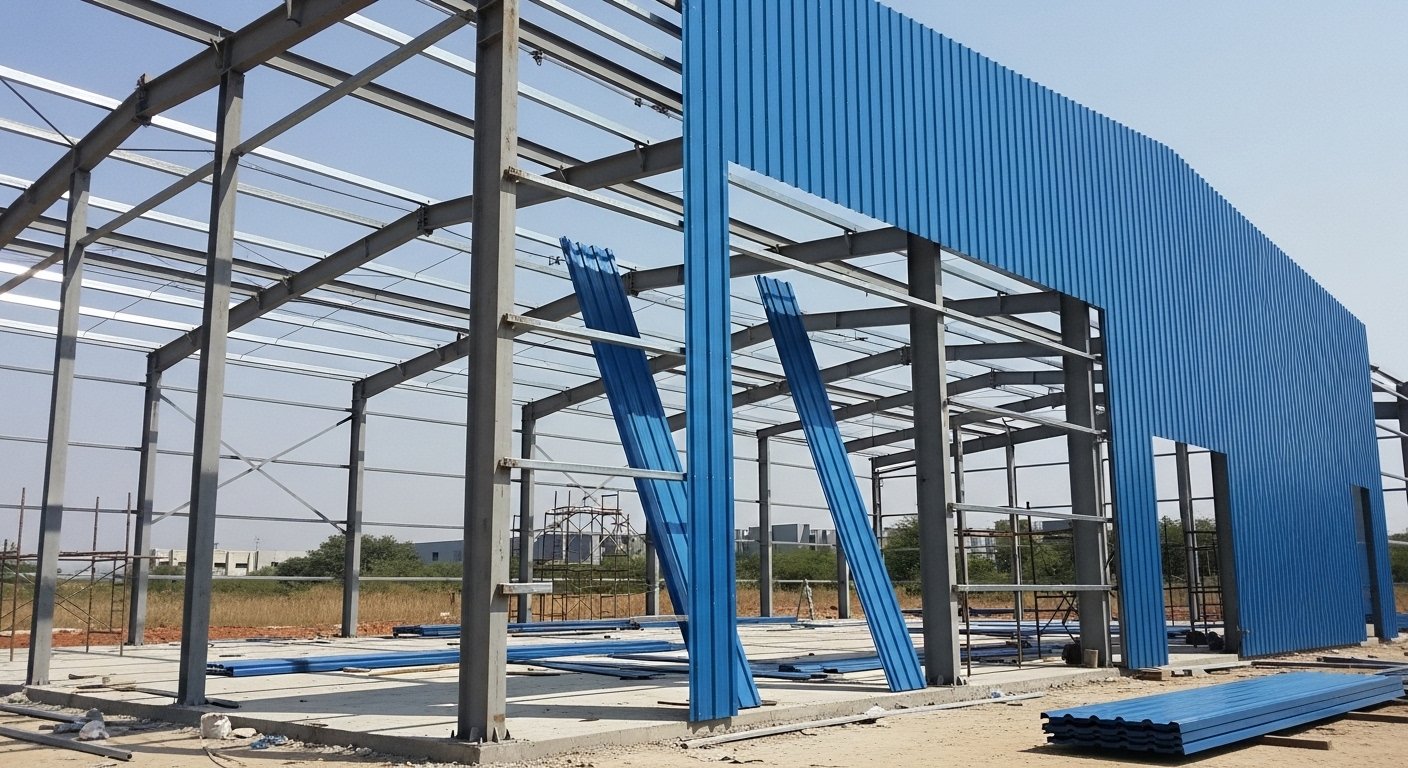
What makes a pre-engineered building different from a conventional steel shed
The distinction between a pre-engineered building and a conventional structural steel building in India is sometimes misunderstood. Both are steel-framed structures. Both use IS 800:2007 as the primary design standard. The difference is in how the primary frame is designed and fabricated. A conventional steel building uses standard hot-rolled sections — universal columns, universal beams — sized by a structural engineer for the specific loads and geometry. A pre-engineered building uses tapered primary frames designed by specialist software that optimises the frame profile to use the minimum amount of steel for the applied loads, producing sections that are thicker at the haunches where bending moments are highest and thinner at mid-span where they are lower. This optimisation typically saves 15 to 25 percent of primary steel weight compared to a conventional frame of equivalent span and loading.
The secondary structure in a pre-engineered building — the purlins that carry the roof cladding and the girts that carry the wall cladding — are cold-formed Z or C sections rather than hot-rolled angles or channels. Cold-formed sections are more efficient for the light spanning loads in cladding support, and they can be produced in coil and cut to length without the minimum order quantities that apply to hot-rolled mill sections.
PEB and industrial EPC scopes use the same fabricator prequalification documentation format as structural steel packages.
Pre-engineered buildings India — what they are used for
Warehouse and logistics pre-engineered buildings
The single largest application of pre-engineered buildings in India is warehouse and logistics construction. The explosion of e-commerce, the formalisation of supply chains following GST, and the growth of third-party logistics operators have together created an enormous demand for large-scale covered warehousing across India. Pre-engineered buildings are the dominant structural system for this segment — for good reason. A standard 20,000 sq m distribution warehouse in a PEB system can be designed, fabricated, and erected in 12 to 16 weeks, at a cost of Rs 1,200 to Rs 1,600 per sq ft including primary steel, purlins, Galvalume roofing sheet, wall cladding, gutters, and downpipes but excluding civil foundations and flooring. The RCC equivalent takes 20 to 28 weeks and costs more on a per-square-foot basis when the additional dead load on the foundations is factored in.
Modern distribution centres need specific features that pre-engineered buildings in India are well suited to provide: 12 to 14 metres of clear internal height for high-bay racking, column-free clear spans of 20 to 40 metres, full-length dock leveller openings in the end walls, and a floor loading capacity of 5 to 10 tonnes per square metre. PEB systems accommodate all of these without difficulty, and the column-free clear span is one of PEB’s strongest characteristics — the tapered frame portal achieves clear spans up to 60 metres without intermediate columns.
Factory and manufacturing pre-engineered buildings
Pre-engineered buildings for factory and manufacturing use in India are more complex than warehouse sheds because manufacturing operations impose loads and requirements that a standard PEB system is not optimised for. Under-slung cranes up to 5 MT capacity can be accommodated within a standard PEB frame without significant design changes. Heavier cranes — 10 MT and above — require stepped columns and crane runway beam brackets that take the PEB frame outside the standard optimisation range. At this point, the cost advantage of PEB over conventional steel narrows, and for cranes above 20 MT, conventional structural steel is almost always the better choice.
For manufacturing pre-engineered buildings in India that need to accommodate light to medium crane loads, mezzanine platforms, or minor process equipment — pharmaceutical packaging plants, food processing facilities, light engineering assembly plants — PEB is still the faster and more cost-effective option if the overall building geometry is rectangular and the crane specification is fixed before design begins. Changes to the crane specification after the PEB design is optimised are expensive — the frame is designed for one specific load case, and revising it requires re-running the optimisation and potentially re-fabricating the primary frames.
Cold storage pre-engineered buildings
Cold storage construction in India uses PEB primary frames in many projects, with the insulated panel envelope applied to the secondary steel framework. The structural system is straightforward — the cold room panels are fixed to the purlins and girts rather than the standard Galvalume cladding. The coordination challenge is ensuring that the purlin and girt spacing, the panel fixing bracket positions, and the thermal bridge mitigation at column bases are all designed before fabrication begins. Suncorporation coordinates cold storage pre-engineered building fabrication with the cold room panel supplier at the design stage, incorporating their fixing requirements into the secondary steel before fabrication, which eliminates the site drilling and modification that adds cost and time on cold storage projects.
Pre-engineered buildings India — the design and fabrication process
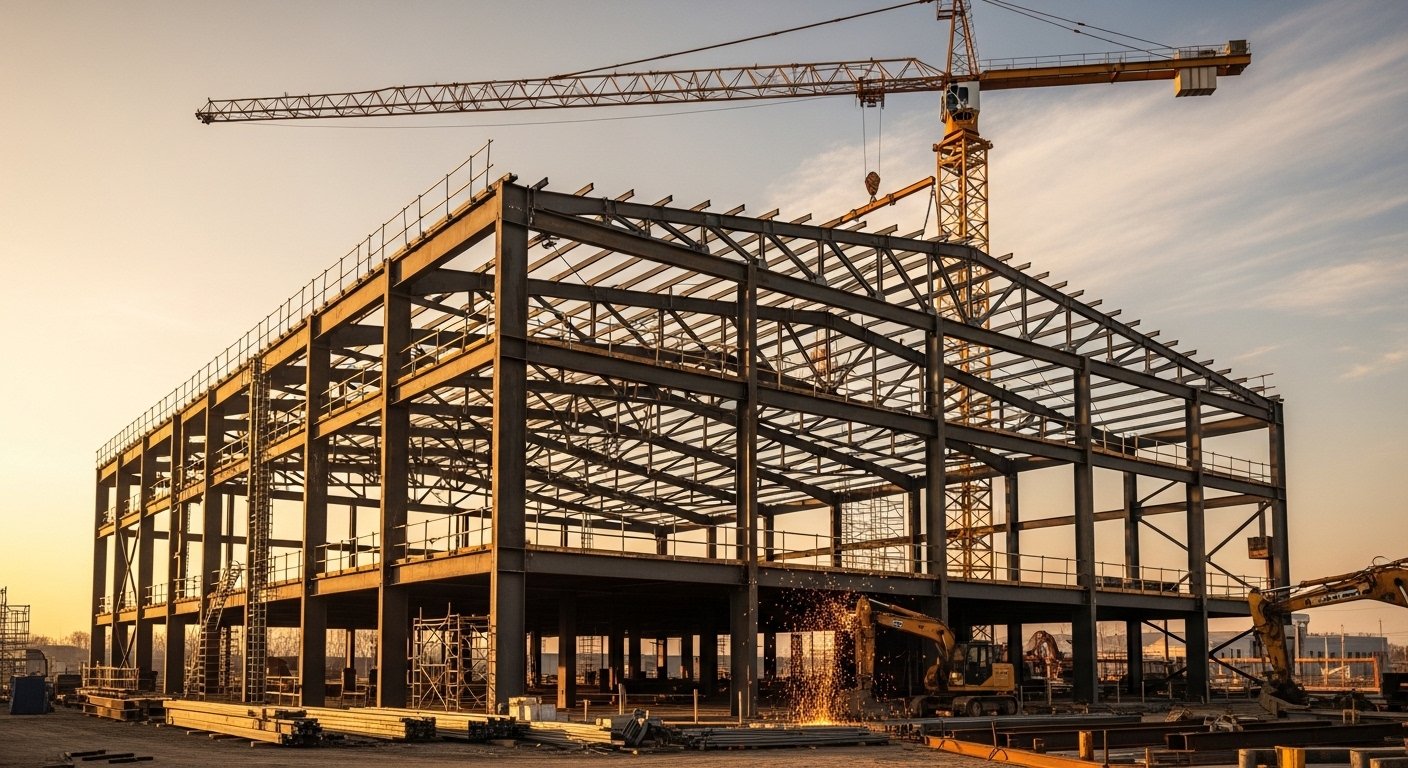
Pre-engineered building design in India starts with the building dimensions, the loading specification, and the site location — which determines the wind zone and seismic zone used in the design. The frame design software takes these inputs and produces the optimised frame profile: the depth and flange thickness of the tapered section at every point along the frame length. The output is a fabrication geometry, not a standard section — the web and flange plates for the tapered frame are cut to the optimised profile from flat plate and welded together in the fabrication workshop.
Purlin and girt design uses cold-formed section design to IS 801. The purlin spacing is set to match the cladding span capacity of the selected roofing sheet, and the girt spacing is set for the wall panel. Eave struts, ridge caps, base angles, and all connecting elements are included in the pre-engineered building kit.
Shop drawings for a pre-engineered building project are prepared by Suncorporation’s detailing team from the approved design output, showing the frame geometry, the connection details at the column base plate and at the ridge, the purlin layout, and the cladding fixing details. These are submitted for client and structural engineer review before fabrication begins. The CNC cutting data for the tapered plates is generated directly from the design software output, eliminating transcription errors.
Pre-engineered buildings India — cladding and roofing systems
The cladding system on a pre-engineered building in India is as important as the structural frame — it is what keeps the rain out, provides the thermal performance, and determines the building’s operational suitability. Standard options for pre-engineered buildings in India include:
- Galvalume roofing sheet — the standard cladding for industrial pre-engineered buildings. 0.47mm or 0.50mm thick AZ150 Galvalume-coated steel sheet in trapezoidal or standing seam profile. Provides 20 to 25 years of maintenance-free service in most Indian industrial atmospheric environments. Cost: Rs 35 to Rs 55 per sq ft of roof area.
- Colour-coated Galvalume (PPGI) — pre-painted Galvalume with a polyester or PVDF top coat in standard colours. Better appearance, equivalent corrosion protection. Cost: Rs 55 to Rs 80 per sq ft depending on paint system and colour.
- Insulated sandwich panels (PIR or PUF) — for temperature-controlled buildings, noise reduction, or industrial facilities requiring better thermal performance. 50mm to 100mm thick sandwich panels with Galvalume-coated steel face skins. Cost: Rs 280 to Rs 450 per sq ft depending on panel thickness and specification.
- Turbo ventilators and ridge ventilators — natural ventilation for hot industrial environments. Standard on factory pre-engineered buildings in India to extract heat from the roof space without mechanical systems.
Pre-engineered buildings India — IS standards that apply
- IS 800:2007 — the primary structural steel design code. All pre-engineered building primary frames in India are designed to IS 800:2007 limit state design method. The tapered frame optimisation must satisfy all IS 800:2007 member capacity checks including lateral-torsional buckling of the rafter and compression flange bracing.
- IS 801:1975 — design of cold-formed steel sections. The purlin and girt design for pre-engineered buildings follows IS 801, which covers cold-formed Z and C sections that are not addressed by IS 800:2007.
- IS 875 Parts 1, 2 and 3 — dead, imposed, and wind loads. Wind load on the cladding and primary frame is a critical design input for pre-engineered buildings in India. The wind zone from IS 875 Part 3 determines the suction pressures on the roof and wall cladding, which govern the purlin and cladding design in many Indian locations.
- IS 1893:2016 — seismic design. Pre-engineered buildings in seismic zones III and above need to satisfy IS 1893 horizontal force requirements. The relatively light weight of PEB primary frames means that seismic forces are often not the governing load case, but the column base plate and anchor bolt design needs to be checked for seismic uplift in high zones.
- IS 2062 — hot-rolled steel for the primary frame plates and connection elements.
- IS 4923 — hollow steel sections used for secondary bracing elements in some PEB designs.
Pre-engineered buildings India — cost per sq ft in 2026
Pre-engineered building costs in India in 2026 depend on span, height, crane provision, cladding specification, and location. The rates below are supply and erect — including primary frame, purlins and girts, standard Galvalume roofing and wall cladding, gutters and downpipes, and all structural fasteners. Civil foundations and flooring are not included.
- PEB warehouse or factory, no crane, span 20 to 40m, eave height 6 to 9m: Rs 1,200 to Rs 1,600 per sq ft supply and erect. Standard wind zone, straightforward rectangular plan.
- PEB with under-slung crane up to 5 MT: Rs 1,400 to Rs 1,800 per sq ft. Crane provision adds crane rail brackets, under-slung track, and reinforced inner columns.
- PEB with EOT crane up to 10 MT (stepped columns): Rs 1,700 to Rs 2,100 per sq ft. Stepped columns and crane runway beam increase primary steel weight significantly.
- PEB with insulated sandwich panel cladding: Add Rs 250 to Rs 400 per sq ft over the standard Galvalume rates above, depending on panel thickness and specification.
- Multi-span PEB (connected parallel bays): Rs 1,100 to Rs 1,500 per sq ft for additional spans. Interior columns are lighter than end frames; cladding on interior bays is reduced to a parapet rather than a full gable end.
Pre-engineered buildings India — timeline from order to erection completion
- Design and drawing approval: 3 to 5 weeks. PEB design is faster than conventional steel detailing because the frame geometry comes from the optimisation software rather than individual member sizing by a structural engineer.
- Procurement: 2 to 3 weeks for plates, cold-formed coil, and Galvalume cladding from stock.
- Fabrication of primary frames: 4 to 8 weeks depending on total tonnage. Tapered frame fabrication is more labour-intensive than standard hot-rolled section fabrication because the plates are individually profiled.
- Transport and erection: 3 to 5 weeks for a standard 5,000 to 15,000 sq m shed with a crew of 15 to 20 erectors.
- Total programme: 12 to 18 weeks from order to weathertight handover for a standard PEB warehouse or factory shed. Civil foundations need to be ready when erection begins — foundation readiness is the most common cause of programme slippage on PEB projects in India.
Why choose Suncorporation for pre-engineered buildings in India
Pre-engineered building procurement in India has a quality problem at the lower end of the market. The optimisation software is widely available, and there are hundreds of companies that will quote you a PEB on a spreadsheet without the workshop capability to fabricate the tapered frames to the design geometry. The most important question when evaluating a PEB supplier in India is not the price — it is whether they fabricate the primary frames in their own workshop, or subcontract to whoever is cheapest that month. Suncorporation fabricates all pre-engineered building primary frames in our own Hyderabad workshop, using our own CNC-cut plates and our own qualified welders. The frame geometry matches the design output because we control the fabrication process from start to finish.
We also erect with our own teams. A pre-engineered building that is fabricated correctly but erected carelessly — columns out of plumb, ridge not aligned, purlin clips improperly positioned — will leak, rack under wind load, and look unprofessional. Our erection supervisor checks plumb and ridge alignment before cladding begins, and our quality documentation covers erection as well as fabrication.
Pre-engineered buildings enquiries — getting a quote from Suncorporation
To get a quotation for a pre-engineered building from Suncorporation, we need: the building dimensions (length, width, eave height, and number of bays), the location and state (for wind zone and seismic zone), the crane specification if any (capacity, span, number, and hoisting height), the cladding preference (standard Galvalume, colour-coated, or insulated panels), and the intended use. A sketch is fine — no structural drawings are needed at the quote stage for a standard PEB. We provide a full scope quotation within 48 hours of receiving the above information.
Contact Suncorporation for pre-engineered buildings India. Also see: Industrial shed fabrication | Cold formed steel purlins | Crane girder fabrication | Structural steel Hyderabad